What you’ll learn
We’ll walk you through how lifestyle changes like diet, exercise, and stress management can ease menopause symptoms, and when to consider medical treatment.
You got the puberty talk. You got the pregnancy talk. But did anyone sit you down and explain what happens when your hormones start winding down in your 40s? Perimenopause is when that shift begins, usually around your mid-40s, with 47 being the average age. That’s often when the hot flashes, sleep trouble, vaginal dryness, and mood swings kick in.
So what can you do? Dr. Sheryl Ross (Dr. Sherry), our Chief Medical Officer of Women’s Health at QuickMD, explains,
A healthy lifestyle goes a long way at any time in your life, but especially in perimenopause. Inactivity, unhealthy diet (fast food!), smoking, obesity, excessive alcohol consumption… if you’re still waiting to remedy any of it, now is the time!
Menopause can upend your life, but you have more control than you might think. Diet, exercise, stress management, and a few changes you might not expect can all make a noticeable difference in how you feel.
Common menopause symptoms
When menopause comes along, it changes more than your cycle. You might have to deal with hot flashes that hit at the worst possible time, night sweats stealing your precious sleep, a sex drive that pulled a disappearing act, or any of the other woes you see on Menopause TikTok. And most women deal with more than one of these at a time.
If you’re in your mid-40s and something feels off, there’s a good chance menopause is behind it. Knowing the full range of menopause symptoms is wider than most expect, and knowing what to look for makes it a lot easier to figure out what to do about it.
What lifestyle changes can help manage menopause symptoms?
Menopause hormone therapy (MHT) gets a lot of the spotlight because of how effective it is. But the way you eat, move, sleep, and manage stress can move the needle on symptom relief more than you’d expect. None of this replaces medical treatment when you need it, but lifestyle changes can work alongside MHT or do some heavy lifting on their own for milder symptoms.
Dietary changes
Knowing which foods to eat and which to avoid during menopause can help you get a handle on the intensity of your symptoms. If you want a plan to follow, DASH and Mediterranean diets are both well-researched and linked to easier‑to‑manage menopause symptoms. They focus on whole foods that support heart health, bone density, steady energy, and reduced inflammation, all of which become more important as estrogen drops. Here are specific food changes that can help:
- Load up on leafy vegetables, fruits, beans, and whole grains. The fiber and antioxidants keep blood sugar steady and digestion running smoothly. This helps prevent blood sugar spikes and crashes, which are linked to mood swings, irritability, fatigue, and overeating.
- Recommended amount:
- Vegetables: 3 to 4 servings/day
- Fruits: 1 or 2 servings/day
- Whole grains: 3 or more servings/day
- Nuts, seeds, legumes: 4 or more/week
- Recommended amount:
- Add healthy fats to the mix in moderation. Olive oil, nuts, seeds, and avocado reduce inflammation and support heart health. These are calorie-dense, so keep portions in check.
- Recommended amount: No more than 7% of your total daily calorie intake.
- Pair calcium with vitamin D for stronger bones. Bone loss accelerates when estrogen declines. Yogurt, leafy greens, fortified plant milks, fatty fish, and egg yolks help keep bones strong. Vitamin D helps your body absorb calcium more easily.
- Recommended amount:
- Women 50 and under: 1,000 mg calcium and 600 to 800 IU vitamin D per day.
- Women 51 and older: 1,200 mg calcium and 800 to 1,000 IU vitamin D per day.
- Recommended amount:
- Work in magnesium-rich foods. Pumpkin seeds, almonds, spinach, and black beans can improve sleep, ease muscle tension, and stabilize mood.
- Recommended amount: 320 mg/day magnesium for women 51 and older.
- Get enough protein each day. Chicken, fish, Greek yogurt, tofu, and lentils help maintain muscle mass, help you feel full, and support your body as it changes.
- Recommended amount: 0.36 to 0.54 grams of protein daily per pound of your total weight. For example, if you weigh 150 lbs., your daily protein goal would be 54 to 81 grams (150 x 0.36 = 54) and (150 x 0.54 = 81).
- Add B-vitamin sources to your daily diet. Eggs, legumes, leafy greens, and fish support energy and brain function, both of which can take a hit during menopause.
- Recommended amount: (for women 51 and older)
- B1 (thiamin): 1.2 mg/day
- B2 (riboflavin): 1.1 mg/day
- B3 (niacin): 14 mg/day
- B6: 1.5 mg/day
- B12: 2.4 mcg/day
- Recommended amount: (for women 51 and older)
- Stay hydrated throughout the day. Dehydration can make hot flashes and bloating worse. Dr. Sherry says, “2 to 3 liters a day is ideal to help minimize water retention and bloating.”
- Cut back on processed foods, added sugar, and known triggers. Sugar and processed foods cause energy crashes and unstable blood sugar. Spicy food, caffeine, and alcohol can ramp up hot flashes and wreck sleep for some women. Limit or cut these where you can.
Regular exercise
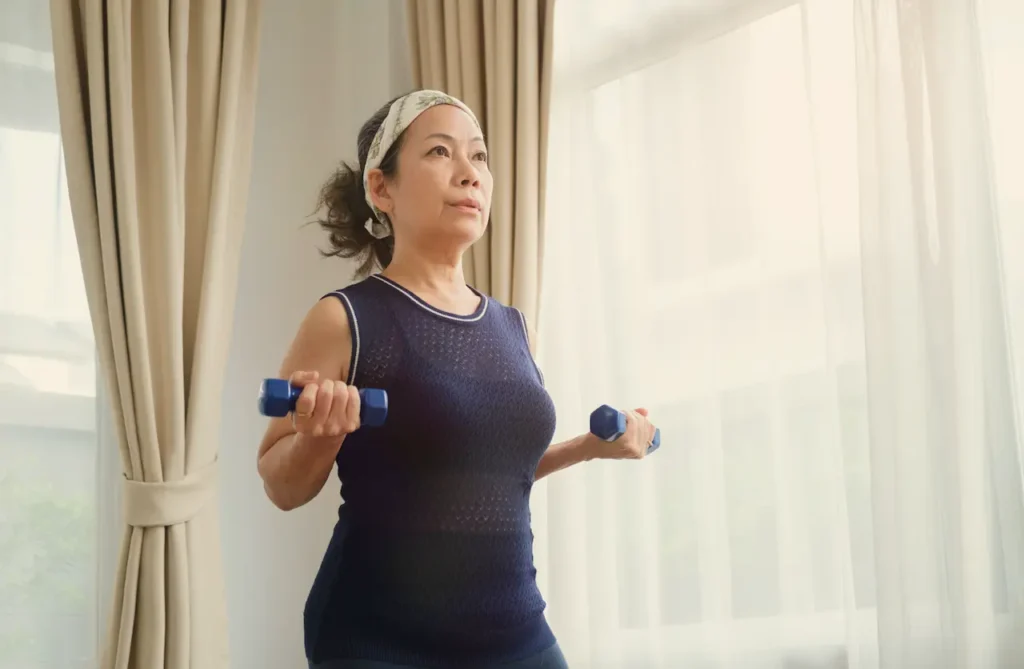
Regular exercise can do a lot for menopause symptoms by improving metabolism, breathing, energy, and emotional stability. Combined with a solid diet, staying active is one of the best things you can do for your bones and body composition as estrogen declines.
Consistency matters more than the intensity of your workouts. Moderate movement you can stick with will do more than occasional intense workouts. Dr. Sherry says, “Exercising as little as 30 minutes, three days a week can show immediate health benefits.”
If you have trouble staying motivated, she recommends tracking your exercises and steps with a fitness tracker or app. “I’ve become obsessed with my Fitbit because I can be very sedentary some days. Keeping track of your steps, aiming for 7,500–10,000 a day, will make you more accountable and successful in monitoring your daily activity,” she says.
| Exercise type | Examples | Why it helps | Recommended frequency |
| Aerobic and cardio | Walking, hiking, dancing, swimming, climbing stairs | Strengthens bones, supports heart health, and helps manage weight | 5 or 6 days for 25–30 minutes per session. Weekly goal of 150 minutes |
| Strength training | Weights, resistance bands, bodyweight exercises | Builds and maintains muscle mass, strengthens bones, and makes everyday tasks easier | 2 to 3 days a week |
| Mind-body and flexibility work | Pilates, tai chi, yoga, stretching | Reduces stress, improves balance and posture, and helps with stiffness and tension | 5–10 minutes on most days |
| High-intensity interval training (HIIT) | Interval walking, cycling intervals, jump rope, jumping jacks | If cleared by your provider, HIIT may help lose belly fat and lower risk of diabetes and heart disease | 1 to 2 times a week followed by a recovery day |
Stress management
Shifting hormone levels can change how your body responds to stress. During menopause, things that used to roll off your back can feel a lot harder to shake. And that heightened stress response can feed right back into hot flashes, sleep problems, and mood swings. This creates a cycle that’s tough to break without some deliberate effort. Here are a few strategies for coping with stress and reclaiming your peace:
- Regularly practice breathing exercises and meditation. Breathing exercises like the 4-7-8 technique and meditation can interrupt acute stress and bring quick relief and relaxation. The more you practice, the more effective these tools become.
- Try therapy or counseling. If anxiety, depression, or mood changes become too much, a therapist can help you build strategies to cope. Cognitive behavioral therapy (CBT) is especially helpful for reframing negative thoughts, beliefs, and expectations that make anxiety, low mood, or physical symptoms worse.
- Protect your downtime with good time management. Overscheduling is a quick way to feel overwhelmed. Cut where you can, delegate tasks, and schedule “me time” every day so you have room to breathe.
- Stay connected to people. Isolation makes stress louder, but socializing can reduce stress and improve your mood. Low-effort connections like texting help, but FaceTime with friends and family does more. Spending time with loved ones in person can take the edge off and strengthen your sense of belonging.
- Learn your stress triggers. Pay attention to what consistently ramps up your stress levels. Once you see the pattern, you can make small changes before symptoms start snowballing.
Quit smoking
When it comes to smoking, Dr. Sherry is very blunt: “Just stop, if not for the fact that smoking increases the risk of heart disease, stroke, lung cancer, and death, but because it makes hot flashes more frequent and severe during perimenopause.” She also points to a recent study showing that women who quit smoking at least 5 years before menopause experienced a significant drop in hot flash frequency and severity.
Beyond hot flashes, smoking disrupts sleep and speeds up bone loss at a time when your body is already losing estrogen’s protective effect. If quitting feels overwhelming, even cutting back is a step in the right direction. Talk to your provider about finding an approach that could work for you.
Limit alcohol and caffeine
That nightly glass of wine might feel like it helps you unwind, but alcohol can make hot flashes worse and disrupt sleep, blood sugar, blood pressure, and emotional stability. Dr. Sherry says, “Alcohol increases your risk of heart disease, liver disease, high blood pressure, diabetes, colorectal and breast cancer, and, now we know, worsens hot flashes—and, by the way, one five–ounce glass of wine is equivalent to 1½ ounces of hard liquor, which may surprise and depress many of you.” For menopausal women, sticking to no more than 3 to 4 servings of alcohol a week is a good target.
Caffeine can increase anxiety, irritability, and heart racing, all of which already tend to run higher during menopause. It can also make hot flashes more frequent and mess with sleep, especially if you’re drinking it past midday. You don’t necessarily need to quit entirely, but try limiting caffeine to no more than one or two servings (of 8 to 12 ounces) per day.
Treatments that can reduce menopause symptoms
Lifestyle changes can take you a long way, but for a lot of women, they’re not enough on their own. If you’ve made adjustments and your symptoms are still too much to handle, you may want to consider menopause hormone therapy (MHT) or non-hormonal medication. MHT is a safe and effective treatment for managing hot flashes, night sweats, fatigue, and other symptoms that come with menopause. Like any medication, MHT isn’t right for everyone, and your doctor will help you decide whether it makes sense for you.
If MHT isn’t an option, Dr. Sherry recommends asking about medications like antidepressants, Gabapentin, or Veozah to help target specific symptoms in ways that diet and exercise can’t.
Finding help with QuickMD for menopause symptom relief
Menopause affects your body, your sleep, your mood, and most of all, your patience. Whether lifestyle changes are enough or you need something more, you can find support here at QuickMD. Our doctors have experience helping women sort through their symptoms to find treatment that works for them.
Frequently asked questions
How long do symptoms of menopause last?
Symptoms like hot flashes and night sweats last around 7 years on average, but can last more than 10 years for some women. Symptoms like vaginal dryness and urinary changes tend to last longer and can actually get worse over time if they go untreated.
How do I know if I’ve reached menopause?
You’ve reached menopause when you’ve gone 12 continuous months without having a period. After that point, you’re in postmenopause. Most women reach it between the ages of 45 and 55, but the timing varies.
When should I see a doctor?
If your symptoms are getting in the way of sleep, work, or how you feel day to day, call your provider. You should also reach out if you have any bleeding after menopause, if you’re thinking about bone or heart health, or if you want to explore whether MHT is right for you.
Disclaimer
Articles on this website are meant for educational purposes only and are not intended to replace professional medical advice, diagnosis or treatment. Do not delay care because of the content on this site. If you think you are experiencing a medical emergency, please call your doctor immediately or call 911 (if within the United States). This blog and its content are the intellectual property of QuickMD LLC and may not be copied or used without permission.
References
Faubion S. (2024). Explaining the stages of menopause. Mayo Clinic Press. https://mcpress.mayoclinic.org/menopause/explaining-the-stages-of-menopause/
National Heart, Lung, and Blood Institute. DASH eating plan. (2025). https://www.nhlbi.nih.gov/education/dash-eating-plan
Cleveland Clinic. (2024). Mediterranean diet. https://my.clevelandclinic.org/health/articles/16037-mediterranean-diet
Silva, T.R., Oppermann, K., Reis, F.M., Spritzer, P.M. (2021). Nutrition in menopausal women: a narrative review. Nutrients. 2021;13(7):2149. https://www.ncbi.nlm.nih.gov/pmc/articles/PMC8308420/
Weiss, C. (2022). Mayo Clinic Q and A: Osteoporosis and supplements for bone health. Mayo Clinic News Network. https://newsnetwork.mayoclinic.org/discussion/mayo-clinic-q-and-a-osteoporosis-and-supplements-for-bone-health/
Healthline. (2020). Magnesium for menopause: efficacy, benefits, and side effects. https://www.healthline.com/nutrition/magnesium-for-menopause
National Institute on Aging. (2021). Vitamins and minerals for older adults. https://www.nia.nih.gov/health/vitamins-and-supplements/vitamins-and-minerals-older-adults
Erdélyi, A., Pálfi, E., Tűű, L., et al. (2024). The importance of nutrition in menopause and perimenopause—a review. Nutrients. 2024;16(1):27. https://pmc.ncbi.nlm.nih.gov/articles/PMC10780928/
Milart, P., Woźniakowska, E., Wrona, W. (2018). Selected vitamins and quality of life in menopausal women. Menopausal Review. 2018;17(4):180-184. https://pmc.ncbi.nlm.nih.gov/articles/PMC6372850/
Cheng, T.Y., Wu, W.T., Peng, C.H., et al. (2024). Effect of aerobic exercise on bone health in postmenopausal women with obesity: Balancing benefits with caloric restriction and resistance exercise. Tzu Chi Medical Journal. 2024;36(4):377-386. https://typeset.io/papers/effect-of-aerobic-exercise-on-bone-health-in-postmenopausal-9td2yyuutw
Mishra, N., Devanshi, Mishra V. (2011). Exercise beyond menopause: dos and don′ts. Journal of Mid-life Health. 2011;2(2):51. https://www.ncbi.nlm.nih.gov/pmc/articles/PMC3296386/
Vaccarino, V., Bremner, JD. (2024). Stress and cardiovascular disease: an update. Nature Reviews Cardiology. 2024;21:1-14. https://www.nature.com/articles/s41569-024-01024-y
UCLA Health. (2024). The best way to work out after menopause. https://www.uclahealth.org/news/article/best-way-work-out-after-menopause
Stute, P., Lozza-Fiacco, S. (2022). Strategies to cope with stress and anxiety during the menopausal transition. Maturitas. 2022;166:1-13. https://www.sciencedirect.com/science/article/pii/S0378512222001670
Gotter, A. (2018). What Is the 4-7-8 breathing technique? Healthline. . https://www.healthline.com/health/4-7-8-breathing
Kim, J.H., Yu, H.J. (2025). Nonpharmacological intervention effects on middle-aged women with menopausal symptoms: a systematic review and meta-analysis. Healthcare. 2025;13(24):3206. https://pmc.ncbi.nlm.nih.gov/articles/PMC12732411/
Smith, R.L., Flaws, J.A., Gallicchio, L. (2022). Does quitting smoking decrease the risk of midlife hot flashes? A longitudinal analysis. Maturitas. 2015;82(1):123-127. https://pmc.ncbi.nlm.nih.gov/articles/PMC4546860
Plumbo, G. (2014). Study suggests caffeine intake may worsen menopausal hot flashes, night sweats. Mayo Clinic News Network. https://newsnetwork.mayoclinic.org/discussion/mayo-clinic-study-suggests-caffeine-intake-may-worsen-menopausal-hot-flashes-night-sweats/
QuickMD has strict referencing policies and relies on reputable sources, including peer-reviewed research, clinical guidelines, medical organizations, and government and public health agencies, among others. Learn more about how we ensure accuracy in our content by reading our editorial guidelines.