What you’ll learn
We’ll go over the types of drug tests that can detect kratom, how long it stays in your system, and what factors can affect your detection window.
In recent years, kratom has become a substance that has gained attention as “a drug of concern” with the U.S. Drug Enforcement Administration (DEA). It’s federally legal but banned in some states, and you can buy it at a gas station or smoke shop, and certain employers can and will test for it.
Are you taking a drug test in the near future and wondering whether kratom is going to be a problem? The short answer is probably not because most standard drug panels don’t test for it. But “probably not” isn’t the same as “definitely not,” and kratom sits in a strange gray area. If you’re in a treatment or court-ordered program, kratom-specific testing is even more likely. If you are considering stopping kratom use, our guide on treating kratom addiction explains what to expect and how to get support. It all comes down to who’s ordering the test and what they’re looking for.
Common types of drug panels
Drug panels aren’t fully standardized, so what gets tested for can vary by employer, program, or lab. Here’s a general breakdown of the most common ones. Kratom likely won’t be included in any of these unless it’s specifically requested.
- 5-panel test: This is the most common test used for federal hiring and general employment. It screens for THC, cocaine, opiates (codeine, morphine, heroin), amphetamines, and PCP.
- 8-panel test: Adds to the 5-panel: 6. Benzodiazepines (Xanax, Valium, Klonopin) 7. Barbiturates (phenobarbital, secobarbital) 8. Methaqualone (Quaalude) — or sometimes replaced with another substance, like MDMA/Ecstasy
- 10-panel test: Builds on the 5-panel test to include drugs, such as benzodiazepines, barbiturates, MDMA, propoxyphene, methadone, and sometimes methaqualone (Quaaludes) or similar sedatives. This test is usually used for jobs that affect public safety, like healthcare or construction.
- 12-panel test: May cover everything in the 10-panel, plus semi-synthetic opioids like oxycodone and synthetic opioids like fentanyl. Some versions also include other prescription or designer drugs, or also include buprenorphine.
- 14-Panel and Beyond (Specialty/Forensic Testing) May additionally include: Tramadol, Fentanyl, Kratom, Synthetic cannabinoids (K2/Spice), Synthetic cathinones (bath salts), Buprenorphine, Carisoprodol (Soma), Zolpidem (Ambien)
These tests can be used in rehab programs, pain management clinics, or other situations where substance use is being monitored.
When can kratom be detected on a drug test?
Kratom only shows up if the drug test is designed to look for its alkaloids, which are natural compounds found in certain plants. For example, coffee has caffeine alkaloids, and kratom has mitragynine and 7‑hydroxymitragynine (7-OH). Standard workplace panels usually don’t test for either of those chemicals.
Kratom-specific testing is more common in situations where substance use is being closely monitored, including:
- Clinical drug monitoring
- Pain management programs
- Addiction treatment
- Some probation or drug-court programs
How long does kratom stay in your system?
Most people clear kratom from their system within about 1 to 2 weeks, though it depends on how much you’ve been taking and how often. That range comes from kratom’s half-life, which is roughly 24 to 45 hours. This means the body cuts its concentration in half during that window, and after 4 to 5 cycles of that, levels drop below what a test can pick up. Heavier or more frequent use can make that detection window last longer. The same half-life cycles also shape how long kratom is detectable, including how 7-OH clears from the body.
| Test type | Detection window | What to know |
| Urine | 5 to 14 days | Most common method. A single low dose clears faster and regular use can push detection past a week |
| Blood | 1 to 4 days | Shorter detection window overall. Picks up recent use but won’t catch much beyond a few days |
| Saliva | 1 to 48 hours | Saliva testing for kratom is rare. Most substances have a short detection window with this method |
| Hair | Up to 90 days | Substances won’t appear in hair for about 7 to 10 days after use since it takes time for new hair growth to carry them out |
Other factors that impact how long kratom can last in your system
Everyone’s body handles kratom a little differently. These are the biggest factors that can affect how long kratom stays in your body and shows up on tests:
- How much you took. A single small dose clears faster than a large one. More kratom means more for your body to process.
- How often you use it. Regular use builds up levels in the body, which means a longer clearance window compared to one-time or occasional use.
- Body composition. Kratom is fat-soluble, so a higher body fat percentage can slow down elimination.
- Metabolism and organ function. Your liver breaks kratom down and your kidneys flush it out. If either one works more slowly (due to age, genetics, or other health conditions), clearance takes longer.
Can kratom cause a false positive on a drug test?
While kratom has opioid and amphetamine-like effects, it usually does not show up as an opiate or amphetamine on the test. However, there have been rare cases of kratom use causing false positives for opioids like methadone.
What are the risks of using kratom?
Kratom can cause a range of short-term side effects such as:
- Nausea and vomiting
- Constipation
- Dry mouth
- Dizziness or drowsiness
- Agitation
- Increased heart rate
At higher doses or with regular use, the risks get more serious with liver injury, seizures, central nervous system depression, and breathing problems. These risks rise when kratom is combined with alcohol, opioids, benzodiazepines, or other medications that slow breathing. Slowed breathing from higher doses or risky combinations is one of the signs of a kratom overdose that needs emergency care.
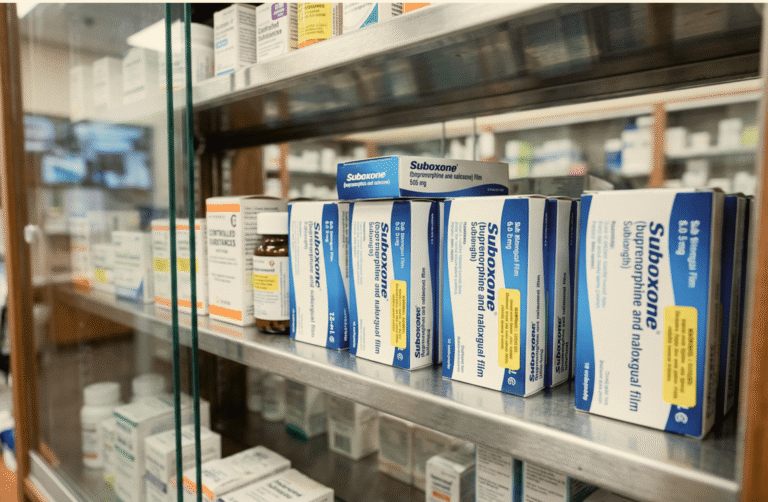
Some people turn to kratom to manage opioid withdrawal on their own. It may seem like a good way to step down from opioid use, but kratom itself can lead to dependence. If you’re trying to get off opioids, there are safer, more reliable options. At QuickMD, our doctors can prescribe medications like Suboxone® through our Medication-Assisted Treatment (MAT) program, if appropriate. Having help from a knowledgeable doctor who can guide you through the process can give you greater peace of mind and added support in recovery. These treatments carry far fewer risks than kratom and are backed by decades of clinical evidence. Our kratom and 7-OH treatment program helps people make this transition safely, with virtual visits often available the same day.
Finding help with QuickMD for kratom dependency
If you’ve been relying on kratom to manage pain, get through the day, or step back from other substances, you’re not the first person to land here. A lot of people start using kratom thinking it’s a safer option, but for some it becomes its own problem. If you are wondering whether that shift counts as addiction, our guide on whether you can get addicted to kratom explains how dependence forms.
At QuickMD, our doctors work with people in just this situation. We work with you to build a plan around what you actually need, whether that’s medication like Suboxone, counseling, or regular check-ins to make sure you feel supported at every step. It all happens with convenient, judgement-free telemedicine visits from the comfort and privacy of your home, so there’s no need to rearrange your schedule or sit in a waiting room to get started.
Frequently asked questions about kratom
Can employers test for kratom use?
Yes, employers can test for kratom, but most don’t. Most workplaces typically use 5, 10, or 12-panel tests to screen for drugs like THC, cocaine, opioids, and amphetamines. Kratom only shows up if an employer specifically asks to test for it.
Is kratom legal?
Kratom is legal in the U.S. at the federal level, but it’s banned or restricted in some states, cities, and counties. As of 2026, kratom is illegal in six states, including Alabama, Arkansas, Indiana, Rhode Island, Vermont, and Wisconsin.
What should I do if I’m worried about kratom showing up on a drug test?
If you think kratom testing could affect your job, your treatment program, or anything else you’re dealing with, talking to a provider is a good first step. They can help you with tapering off kratom, withdrawal support, and seeking safer alternatives such as Suboxone.
Can kratom be contaminated with other substances?
Yes, the FDA has warned that kratom products could be contaminated with Salmonella and heavy metals like lead and nickel. Salmonella contamination can cause serious foodborne illness leading to diarrhea, fever, and abdominal cramps. Heavy metals are a longer-term concern, with potential damage to the kidneys and nervous system, and links to certain cancers with prolonged exposure.
Disclaimer
Articles on this website are meant for educational purposes only and are not intended to replace professional medical advice, diagnosis or treatment. Do not delay care because of the content on this site. If you think you are experiencing a medical emergency, please call your doctor immediately or call 911 (if within the United States). This blog and its content are the intellectual property of QuickMD LLC and may not be copied or used without permission.
References
United States Drug Enforcement Agency (DEA). (2020.) Kratom: Drug Fact Sheet. https://www.dea.gov/sites/default/files/2020-06/Kratom-2020_0.pdf
FMCSA. (2024). Which substances are tested? https://www.fmcsa.dot.gov/regulations/drug-alcohol-testing/which-substances-are-tested
Johnson, J. (2019). 10-panel drug test: which drugs, timeframes, and results. Medical News Today. https://www.medicalnewstoday.com/articles/326305
Schmidt, E. (2025). Does kratom show up on a drug test? ACS Lab. https://www.acslab.com/kratom/does-kratom-show-up-on-a-drug-test
Tanna, R.S., Nguyen, J.T., Hadi, D.L., et al. (2022). Clinical pharmacokinetic assessment of kratom (mitragyna speciosa), a botanical product with opioid-like effects, in healthy adult participants. Pharmaceutics. 2022;14(3):620. https://pmc.ncbi.nlm.nih.gov/articles/PMC8950611/
Hallare, J., Gerriets, V. (2023). Elimination half-life of drugs. PubMed. https://www.ncbi.nlm.nih.gov/books/NBK554498/
Meireles, V., Rosado, T., Barroso, M., et al. (2019). Mitragyna speciosa: clinical, toxicological aspects and analysis in biological and non-biological samples. Medicines. 2019;6(1):35. https://www.ncbi.nlm.nih.gov/pmc/articles/PMC6473843/
Wananukul, W., Trakulsrichai, S., Sathirakul, K., et al. (2015). Pharmacokinetics of mitragynine in man. Drug Design, Development and Therapy. April 2015:2421. https://pmc.ncbi.nlm.nih.gov/articles/PMC4425236/
Hadland, S.E., Levy, S. (2016). Objective Testing. Child and Adolescent Psychiatric Clinics of North America. 2016;25(3):549-565. https://www.ncbi.nlm.nih.gov/pmc/articles/PMC4920965/
Pierre, C., Gineste, C., Bazydlo, L. (2020). A kratom metabolite causes false positive urine drug screening results for methadone. American Journal of Clinical Pathology. 2020;154(Supplement_1):S19-S20. doi:https://doi.org/10.1093/ajcp/aqaa137.035. https://academic.oup.com/ajcp/article/154/Supplement_1/S19/5942516
U.S. Food and Drug Administration. (FDA). (2019). FDA and kratom. https://www.fda.gov/news-events/public-health-focus/fda-and-kratom
Mayo Clinic. (2023). Kratom for opioid withdrawal: Does it work? https://www.mayoclinic.org/diseases-conditions/prescription-drug-abuse/in-depth/kratom-opioid-withdrawal/art-20402170
Enema, O.J. (2025). States where kratom is illegal 2026: recent kratom bans in states. Life Justice Law Group. https://lifejusticelaw.com/states-where-kratom-is-illegal/
FDA. (2024). Outbreak of salmonella infections linked to products contain kratom. Human Foods Program. https://www.fda.gov/food/hfp-constituent-updates/fda-investigates-multistate-outbreak-salmonella-infections-linked-products-reported-contain-kratom
FDA. (2019). Laboratory analysis of kratom products for heavy metals. U.S. Food and Drug Administration. https://www.fda.gov/news-events/public-health-focus/laboratory-analysis-kratom-products-heavy-metals
QuickMD has strict referencing policies and relies on reputable sources, including peer-reviewed research, clinical guidelines, medical organizations, and government and public health agencies, among others. Learn more about how we ensure accuracy in our content by reading our editorial guidelines.