What you’ll learn
We’ll compare how codeine and hydrocodone differ in strength and uses, what side effects to expect from each, and when it’s time to talk to your doctor about any concerns you might have.
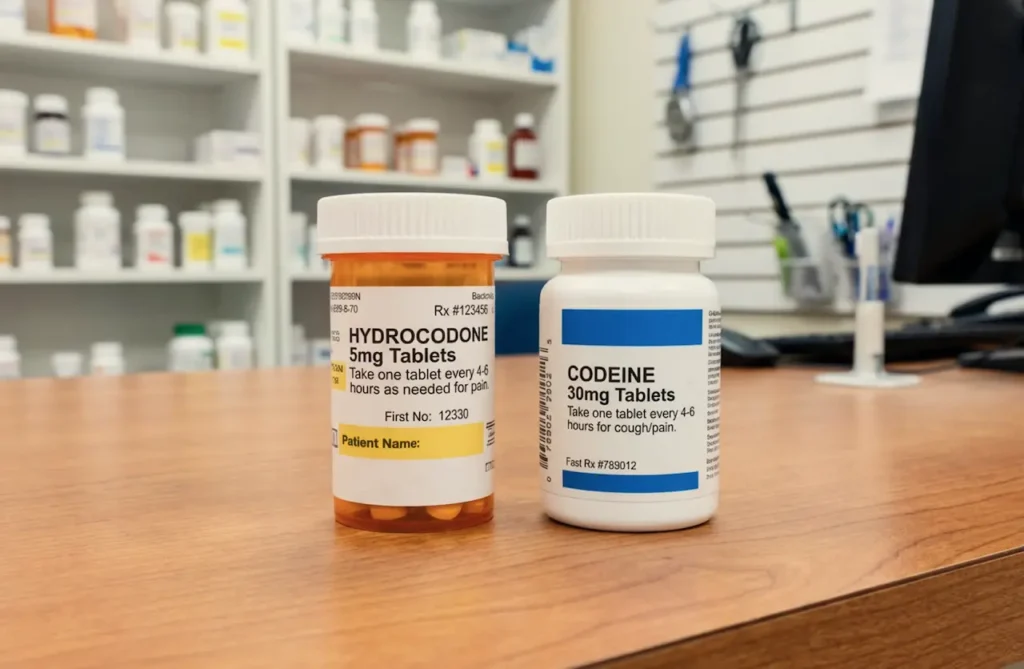
From moderate to severe pain after having a tooth removed to ongoing pain after an injury, managing pain usually means using the lowest-risk treatment that still provides relief. When over-the-counter medicines won’t cut it, codeine and hydrocodone are typical next steps. Both are among the most commonly prescribed opioids in the US, but they differ in potency and potential for developing dependency.
Codeine is the milder option for things like dental procedures or minor injuries, while hydrocodone is stronger and used for post-surgical pain or fractures. That strength difference affects everything from how much relief you’ll get to what side effects you might deal with.
What is hydrocodone?
Hydrocodone is a semisynthetic opioid. This means it’s made in a lab by modifying natural compounds taken from opium poppies. It’s usually used for moderate to severe pain from surgery or chronic conditions, and as a cough suppressant. It’s most often combined with acetaminophen or ibuprofen, so you get better pain relief with less hydrocodone.
Hydrocodone can be considered a medium-strength opioid, making it less potent than morphine but stronger than codeine. It’s a Schedule II drug, which means it has legitimate medical uses but also carries a high risk for developing dependence, even when taken as prescribed by a doctor.
What is codeine?
Codeine is a natural opioid that comes straight from opium poppies. It’s usually prescribed for mild to moderate pain and as a cough suppressant. You might commonly find it in prescription cough syrups. It can also be used off-label for restless legs syndrome or diarrhea. It’s one of the mildest opioids available and is usually combined with other non-narcotic drugs like acetaminophen or ibuprofen to make it work better for pain.
Just because codeine is milder doesn’t mean it’s risk-free. Taking it longer than prescribed or not following your prescription instructions can lead to physical dependence or even overdose. Codeine products range from Schedule II to Schedule V controlled substances, and some versions are riskier than others. For example, pure codeine tablets are Schedule II and have a higher addiction potential than a Schedule V cough syrup with a low dose of codeine.
Hydrocodone vs. codeine
While both hydrocodone and codeine treat similar conditions, they differ in important ways. Doctors consider pain severity, side effects, and addiction risk when choosing which to prescribe. Here’s how they compare:
| Hydrocodone | Codeine | |
| Where it comes from | Made in a lab by chemically modifying codeine or thebaine (both from opium poppies) | Naturally extracted from opium poppies |
| Why doctors prescribe it | Moderate to severe pain, cough suppressant | Mild to moderate pain, cough suppressant, diarrhea, restless legs syndrome |
| Common side effects | Constipation, drowsiness, nausea, dizziness, dry mouth, slowed breathing, low blood pressure | Constipation, drowsiness, nausea, dizziness, dry mouth, itching, and flushing (histamine response) |
| Strength differences | 4.4 to 6.6 times stronger than codeine | About 15–23% as strong as hydrocodone |
| Drug scheduling | Schedule II | Schedule II to Schedule V, depending on how it’s made |
| Risk of dependency | Higher risk. Creates stronger euphoria and sedation, making it more likely to be misused | Lower risk. Milder effects mean less potential for misuse |
Does hydrocodone contain codeine?
Hydrocodone does not contain codeine, though it’s a pretty common mix-up. They’re two different opioids that are chemically related. The confusion usually happens because:
- They come in similar combination products. Both are often paired with acetaminophen or come in syrups for pain or cough, making them seem interchangeable.
- Hydrocodone is made from codeine, but the manufacturing process transforms it into a different opioid. No codeine remains in the final product.
- The names sound alike. It’s easy to assume the “codone” part means there’s codeine in it, but that’s just how the naming system works for related opioids.
Although these are different drugs, it’s important to know about their chemical similarity if you have allergies. If you’re allergic to codeine, you may react to hydrocodone, too.
Hydrocodone and codeine dosage forms
Hydrocodone and codeine both come as prescription-only oral medications, but they’re available in different forms depending on what your doctor needs to treat. Here are the forms you’ll see:
| Dosage Form | Hydrocodone | Codeine |
| Immediate release tablet | ✔ | ✔ |
| Immediate release capsule | ✔ | ✔ |
| Extended-release tablet | ✔ | ✔ |
| Extended-release capsule | ✔ | |
| Oral solution or syrup | ✔ | ✔ |
| Extended-release oral suspension | ✔ | ✔ |
| Combined w/ non-opioid pain relievers (NSAIDs, acetaminophen, aspirin) | ✔ | ✔ |
| Combined w/ antihistamines | ✔ | ✔ |
| Combined w/ decongestants | ✔ | ✔ |
| Combined w/ caffeine | ✔ |
When to get professional help
If you’re taking an opioid for pain and notice you need higher doses to get the same relief, or you feel unwell between doses, it may be time to talk to a healthcare provider. These may be signs your body is becoming dependent, and getting help early gives you more treatment options.
Here at QuickMD, we specialize in treating opioid dependency. Our providers can assess your situation, talk through your options, and create a personalized treatment plan with zero judgment. We offer confidential virtual visits where you can discuss safe tapering, Medication-Assisted Treatment (MAT), and get ongoing support, no matter what you’re dealing with.
Disclaimer
Articles on this website are meant for educational purposes only and are not intended to replace professional medical advice, diagnosis or treatment. Do not delay care because of the content on this site. If you think you are experiencing a medical emergency, please call your doctor immediately or call 911 (if within the United States). This blog and its content are the intellectual property of QuickMD LLC and may not be copied or used without permission.
References
National Institute on Drug Abuse. (2021). Prescription Opioids Drugfacts. https://nida.nih.gov/publications/drugfacts/prescription-opioids
National Institute for Health and Care Excellence (NICE). (2015). Restless legs syndrome: Oxycodone/naloxone prolonged release. https://www.nice.org.uk/advice/esnm67/resources/restless-legs-syndrome-oxycodonenaloxone-prolonged-release-pdf-1502681110261189
PDQ Supportive and Palliative Care Editorial Board. (2002). Cancer Pain (PDQ®): Health Professional Version. National Institutes of Health. https://www.ncbi.nlm.nih.gov/books/NBK65949.1/
Cofano, S., Yellon, R. (2022). Hydrocodone – StatPearls. National Institutes of Health. https://www.ncbi.nlm.nih.gov/books/NBK537288/
Naqvi, R. (2023). Opioids used for mild to moderate pain: efficacy, safety, and considerations. ResearchGate. https://www.researchgate.net/publication/374164262_-NC-ND_40_1_Opioids_used_for_mild_to_moderate_pain_efficacy_safety_and_considerations
Peechakara, B.V., Gupta, M. (2024). Codeine – StatPearls. National Institutes of Health. https://www.ncbi.nlm.nih.gov/books/NBK526029/
QuickMD has strict referencing policies and relies on reputable sources, including peer-reviewed research, clinical guidelines, medical organizations, and government and public health agencies, among others. Learn more about how we ensure accuracy in our content by reading our editorial guidelines.