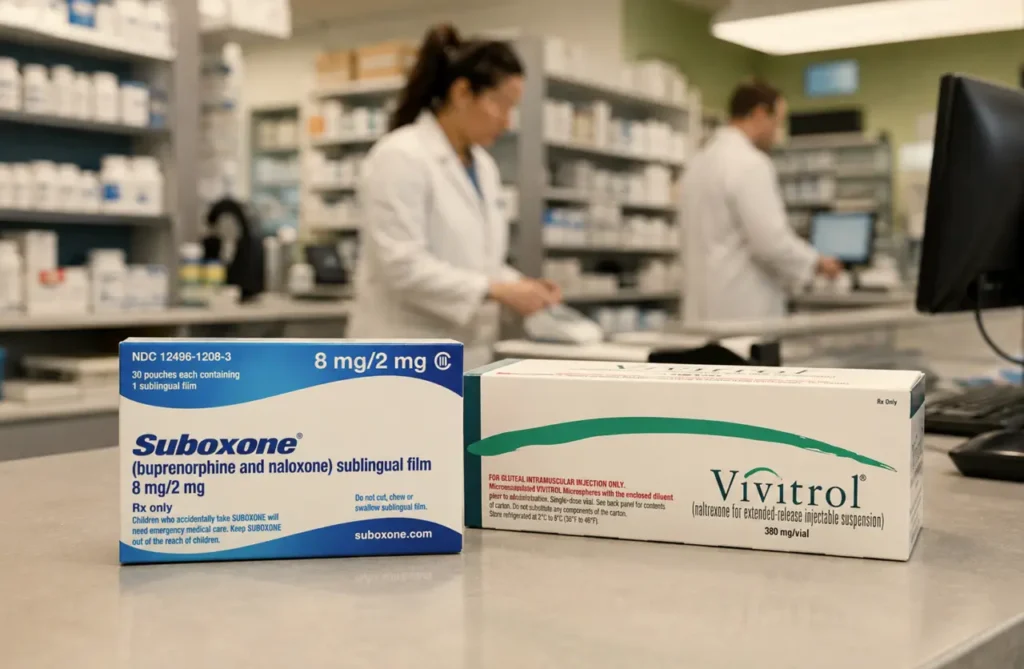
What you’ll learn
We’ll walk you through how Vivitrol® and Suboxone® work in the body and how starting each one looks different from day one. We’ll also explain how the two compare in terms of safety and side effects, plus what the research says about outcomes for people who use them.
Weighing your options for opioid use disorder treatment can feel like a lot to take in, especially if you’re doing it before you’ve even talked to a doctor. That’s a smart place to start, though, because walking into that conversation with a clear picture of how these two medications work can make the whole thing feel less overwhelming.
What is Vivitrol, and how does it work?
Vivitrol® is the brand name for extended-release injectable naltrexone, given as a once-monthly intramuscular injection. Naltrexone is an opioid antagonist: Instead of activating opioid receptors, it blocks them, so it doesn’t relieve withdrawal or cravings the way an opioid-based medication does. Two conditions have FDA approval for Vivitrol: relapse prevention after completing opioid detox and treatment for alcohol use disorder.
What is Suboxone, and how does it work?
Suboxone® is the brand name for buprenorphine-naloxone, a daily sublingual film taken under the tongue. Buprenorphine is a partial opioid agonist, meaning it eases withdrawal and cravings without producing the same effects as a full opioid, and the naloxone component discourages nonmedical use. The FDA approves the buprenorphine-naloxone combination for opioid use disorder as part of a complete treatment plan that includes counseling.
Vivitrol vs. Suboxone: how starting treatment is different
The dosing schedule and starting period differ between Vivitrol and Suboxone (buprenorphine-naloxone).
| Vivitrol | Suboxone | |
| Opioid-free period required before starting | At least 7 to 10 days, longer after methadone or buprenorphine | Started once mild to moderate withdrawal appears, typically hours after last use, not days |
| Dosing schedule | One injection every 4 weeks, given by a clinician | One dose daily, self-administered at home |
| Risk if started too early | Can trigger sudden, severe precipitated withdrawal | Can also cause precipitated withdrawal, but the window is hours, not days |
The opioid-free requirement is the main practical barrier to starting Vivitrol, and it’s a factor a doctor weighs alongside a patient’s individual situation. Suboxone’s shorter window is one reason it can be started sooner after a patient’s last opioid use. This difference doesn’t tell you which medication fits your situation. It’s information worth bringing into your conversation with a doctor.
How Vivitrol and Suboxone compare on safety and side effects
Suboxone (buprenorphine-naloxone) and Vivitrol are commonly used to treat opioid use disorder. Like any medication, each has potential side effects and safety considerations.
| Vivitrol | Suboxone | |
| Key safety considerations | Overdose risk if opioid tolerance is lost and opioids are then used to try to override the blockade; injection site reactions, which can occasionally be severe; possible liver effects at higher than approved doses | Serious breathing problems when combined with alcohol, benzodiazepines, or other sedatives; potential neonatal opioid withdrawal syndrome in babies exposed during pregnancy |
| Common side effects | Nausea, injection site pain or swelling, headache, trouble sleeping | Headache, nausea, constipation, sweating |
Not everyone experiences side effects, and many can be managed with guidance from a doctor. Your doctor can help you understand the potential risks and benefits of each medication based on your health history and individual needs.
How Vivitrol and Suboxone compare in daily life and access
A clinician gives the Vivitrol shot once a month, during an in-person office visit. While the injection itself must be given in person, some clinicians may offer an initial consultation through telemedicine to discuss treatment options and determine whether Vivitrol is appropriate.
Suboxone (buprenorphine-naloxone) works differently. You can take it once a day, often at home. It can be prescribed in person or by telemedicine. The whole process of evaluation, prescription, and follow-up can often be done via telemedicine, including through QuickMD, without an office visit for a shot.
Suboxone (buprenorphine-naloxone) is widely recommended as a first-line treatment for opioid use disorder because of its proven effectiveness and accessibility. For patients ready to begin treatment, same-day Suboxone care through QuickMD offers a convenient way to connect with a doctor and explore treatment options from home.
What does the research say about effectiveness?
The X:BOT trial, funded by the federal government, is the largest head-to-head comparison of these two medications so far. Researchers randomly assigned 570 patients at eight community treatment programs to either extended-release naltrexone (Vivitrol) or buprenorphine-naloxone (Suboxone). Once a patient successfully started either medication, the two performed about the same at keeping people relapse-free.
A more significant difference was seen in how easily patients could begin treatment. Because Vivitrol requires patients to be opioid-free before starting, some patients had difficulty meeting this requirement and were unable to initiate treatment.
Frequently asked questions about Vivitrol and Suboxone
Can I switch from Vivitrol to Suboxone?
This is a medical decision that depends on your individual history and needs to be managed by a doctor, since starting Suboxone (buprenorphine-naloxone) too soon after a Vivitrol injection can affect how the medication works in your body. If you’re considering a switch, that’s exactly the kind of question to bring to a doctor rather than manage on your own.
Does Vivitrol cause withdrawal symptoms?
Vivitrol doesn’t relieve withdrawal, since it blocks opioid receptors instead of activating them. If it’s given before a person is fully opioid-free, it can trigger sudden and severe precipitated withdrawal, which is why the opioid-free period before the first injection is important.
What happens if I miss a Vivitrol injection?
Missing a dose means the medication’s blocking effect wears off over time, and opioid tolerance can drop. That combination raises overdose risk if opioids are used after a missed or delayed injection, so a missed dose is worth calling your clinician about as soon as you notice it.
Can I drink alcohol while taking Vivitrol or Suboxone?
Alcohol use with Suboxone (buprenorphine-naloxone) can cause serious breathing problems, especially in combination with other sedatives. Vivitrol is also approved to treat alcohol use disorder. Combining alcohol with either medication is a question to raise directly with your doctor, since the safety picture depends on how much and how often.
Disclaimer
Articles on this website are meant for educational purposes only and are not intended to replace professional medical advice, diagnosis or treatment. Do not delay care because of the content on this site. If you think you are experiencing a medical emergency, please call your doctor immediately or call 911 (if within the United States). This blog and its content are the intellectual property of QuickMD LLC and may not be copied or used without permission.
References
Alkermes, Inc. VIVITROL (naltrexone for extended-release injectable suspension) [prescribing information]. Waltham, MA: Alkermes, Inc.; 2022. https://www.accessdata.fda.gov/drugsatfda_docs/label/2022/021897s057lbl.pdf
Indivior Inc. SUBOXONE (buprenorphine and naloxone) sublingual film [prescribing information]. North Chesterfield, VA: Indivior Inc.; 2022. https://www.accessdata.fda.gov/drugsatfda_docs/label/2022/022410s046s047lbl.pdf
Massachusetts Department of Public Health, Bureau of Substance Addiction Services. Fact sheet: Lee et al. and Tanum et al. research articles. Accessed September 2026. https://www.mass.gov/doc/factsheet-lee-et-al-tanum-et-al-research-articles/download
QuickMD has strict referencing policies and relies on reputable sources, including peer-reviewed research, clinical guidelines, medical organizations, and government and public health agencies, among others. Learn more about how we ensure accuracy in our content by reading our editorial guidelines.