What you’ll learn
We’ll walk you through how antidepressants and Suboxone® interact, the rare risks worth knowing about, and why treating depression or anxiety alongside your addiction treatment is a normal, helpful part of your care.
If you’re managing depression or anxiety while taking Suboxone® (buprenorphine-naloxone), you may be wondering whether treatment for both can work together safely. It’s a common concern, and an important one to raise.
Depression and anxiety don’t pause just because you’re focused on recovery, and left untreated, they can make staying on track harder than it needs to be. Most standard antidepressants have a well-established safety profile alongside Suboxone, and your QuickMD doctor can help you manage both.
Can you take antidepressants with Suboxone?
For most people, yes. SSRIs and SNRIs (the antidepressants doctors prescribe most often, like Zoloft, Prozac, or Cymbalta) are generally considered safe to take alongside Suboxone under a doctor’s care.
Buprenorphine, the main medicine in Suboxone, is classified as low risk for the interaction people worry about most: serotonin syndrome. The cautions that do apply are narrow and specific. They’re not a reason to avoid treating your depression or anxiety while in recovery. We cover those cautions below.
If you’ve searched interactions online, you may have come across an automated interaction checker flagging a “moderate interaction” with little clinical context. That kind of flag can look more alarming than it is. The full picture is more reassuring, and it’s worth bringing up with your QuickMD doctor directly.
How Suboxone and antidepressants interact
Buprenorphine isn’t a strongly serotonin-acting medicine. Government and clinical reviews place it in the low-risk group for serotonin interactions, meaning it’s considered safe to combine with SSRIs, SNRIs, and TCAs (tricyclic antidepressants, an older class still used for some patients).
The two medications also aren’t working against each other. Suboxone stabilizes your opioid receptors, easing cravings and withdrawal, while antidepressants adjust the brain chemicals tied to mood. They’re addressing two different systems.
The real caution is combining several serotonin-acting medicines at once, or using an older MAOI antidepressant (like Nardil, Parnate, or Marplan, a class rarely prescribed today). Since your QuickMD doctor already knows your medication history, adding an antidepressant to your existing plan is usually a straightforward step.
Before adding anything new, your QuickMD doctor reviews everything you’re taking to help keep the combination safe. The review isn’t a hurdle standing between you and treatment; it’s how your doctor keeps your care safe as your treatment continues. Your QuickMD doctor has experience treating patients on both Suboxone and antidepressants, and the process is more routine than it might feel.
Serotonin syndrome: how real is the risk?
Serotonin syndrome comes from too much serotonin activity in the body, and it usually takes two or more serotonin-acting medicines together to cause it. With buprenorphine plus a standard antidepressant, serotonin syndrome is rare, and buprenorphine isn’t expected to cause it on its own.
Still, it’s worth knowing the signs, so you can know what to watch for if they ever come up:
- Agitation or restlessness that feels new or out of proportion
- A fast heartbeat
- Heavy sweating
- Shivering or muscle twitching
- A high temperature
- Diarrhea
If several of these show up together, especially after starting or changing a medication, seek medical attention.
There’s at least one documented case of serotonin syndrome triggered by a single dose of Suboxone, which is exactly why doctors review your medications rather than dismissing the risk outright. It’s a reason to stay in touch with your QuickMD doctor while you’re on both medications, not a reason to avoid treating your depression or anxiety.
What about heart rhythm (QTc)?
Buprenorphine has only a small effect on your heart’s rhythm, known as the QTc interval, and it’s not typically a concern. If you don’t have existing heart risk factors, it’s unlikely to cause a problem on its own.
Some antidepressants, including certain tricyclics (older prescription antidepressants) and higher doses of citalopram, can also affect your QTc interval. That’s not a reason to avoid either medication. Your QuickMD doctor will look at your specific situation and any heart-related risk factors as they work with you to create a treatment plan. It’s a routine part of how your care stays safe.
None of this works, though, without honesty about what you’re actually taking.
If you’re seeing more than one doctor, say your QuickMD doctor for Suboxone and a separate primary care doctor, psychiatrist, or specialist for anything else; each one needs your complete medication list, not just the medications they personally prescribe. That includes over-the-counter medications and supplements, since those can affect heart rhythm and serotonin levels too. Being upfront with every doctor you see is what lets any of them catch a risky combination before it becomes a problem.
Antidepressants by type with Suboxone
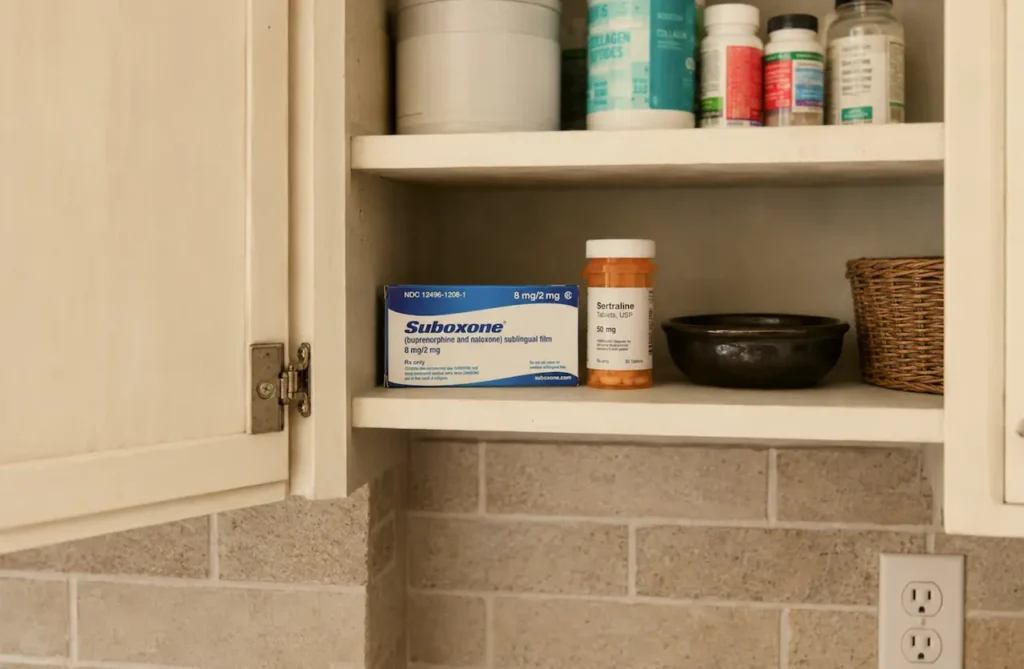
Your QuickMD doctor can prescribe sertraline or another antidepressant based on your symptoms, your other medications, and how you’ve responded to treatment before. You won’t have to figure out which antidepressant is right for you on your own. You and your QuickMD doctor will work together to decide the best treatment option for you.
| Type | Common examples | Safety | What to watch |
| SSRIs | sertraline (Zoloft®), escitalopram (Lexapro®), fluoxetine (Prozac®) | Generally safe; often the first choice | Standard monitoring for typical SSRI side effects |
| SNRIs | venlafaxine (Effexor®), duloxetine (Cymbalta®) | Generally safe | Same low-risk profile as SSRIs |
| TCAs | amitriptyline, nortriptyline | Usable, but with more sedation | Some QT caution, especially at higher doses |
| MAOIs | phenelzine, tranylcypromine | Rarely used today | Needs extra care and close doctor supervision |
Treating depression and anxiety during MAT is normal
Depression and anxiety alongside opioid use disorder are common, and treating both is a standard, helpful part of recovery, not a sign that something’s wrong with your treatment plan. Leaving depression or anxiety untreated can actually make it harder to stay on track with recovery, so addressing both together often works better than treating just one.
That’s part of why coordinated care matters:
- Your QuickMD doctor can manage both your Suboxone and your mental health medication in one place, online, so your care stays coordinated instead of split across separate clinicians who aren’t talking to each other.
- We serve patients in 40+ states, so online mental health treatment and addiction treatment are available on one platform.
- Bringing up a mood or anxiety concern with the same doctor who manages your Suboxone means one person has the full picture, which makes safer, faster adjustments possible if you ever need them.
If you want to know more about how these two areas of care work together, see our guide to Suboxone and mental health.
Never start, stop, or change your medications on your own
Any change to your Suboxone, an antidepressant, or any medication should go through your QuickMD doctor first, since stopping either one suddenly can cause problems, like withdrawal symptoms returning or discontinuation effects from an antidepressant. If something isn’t working or you want to talk about a change, that’s exactly what your next visit is for.
Frequently asked questions about antidepressants and Suboxone
Can you take Zoloft (sertraline) with Suboxone?
Yes, sertraline (Zoloft) is generally considered safe to take with Suboxone under your doctor’s care. Buprenorphine, the medicine in Suboxone, falls in the low-risk group for the interaction people often worry about. Still, tell your QuickMD doctor about every medication you take so they can confirm it fits your full picture.
Can Suboxone itself cause or worsen your depression?
No, buprenorphine, the medicine in Suboxone, is not known to cause depression. A National Institute on Drug Abuse-backed study found that patients starting buprenorphine treatment saw their depression and anxiety scores drop over 12 weeks, even without added counseling. If your depression feels worse while you’re in treatment, tell your doctor. That’s usually a sign your depression needs its own attention, not a side effect of your Suboxone.
Can you take St. John’s Wort or other herbal supplements with Suboxone and an antidepressant?
Before adding St. John’s Wort or any herbal supplement to your Suboxone treatment, talk to your QuickMD doctor. St. John’s Wort speeds up the same liver enzyme your body uses to break down buprenorphine, which can lower how much stays in your system. Bring every supplement you take to your doctor’s attention, not just your prescription medications.
Can you take Wellbutrin® (bupropion) with Suboxone?
Generally, yes. Bupropion (Wellbutrin) works differently from SSRIs and SNRIs and isn’t strongly linked to serotonin syndrome. However, bupropion should not be used in patients with a seizure disorder or certain conditions that increase the risk of seizures. Your QuickMD doctor will review your full medication list and health history, including any history of seizures or other seizure risk factors, before determining whether bupropion is appropriate for you.
Do you need to tell your therapist or psychiatrist that you’re taking Suboxone?
Yes, tell your therapist or psychiatrist, and anyone else treating you, that you’re taking Suboxone. That way, all your doctors can see your full medication list and adjust your treatment plan safely together. Your QuickMD doctor can also help manage both your Suboxone and your mental health medication in one place.
Disclaimer
Articles on this website are meant for educational purposes only and are not intended to replace professional medical advice, diagnosis or treatment. Do not delay care because of the content on this site. If you think you are experiencing a medical emergency, please call your doctor immediately or call 911 (if within the United States). This blog and its content are the intellectual property of QuickMD LLC and may not be copied or used without permission.
References
Isenberg, D., & Wong, S. C. (2008). Serotonin syndrome triggered by a single dose of Suboxone. PMID 18774063. https://pubmed.ncbi.nlm.nih.gov/18774063/
Perananthan, V., & Buckley, N. A. (2021). Opioids and antidepressants: which combinations to avoid. Australian Prescriber, 44(2), 41–44. Summarized by Medsafe New Zealand. https://www.medsafe.govt.nz/profs/PUArticles/September2022/Opioids-and-serotonergic%20medicines-risk-of-serotonin-syndrome.html
Substance Abuse and Mental Health Services Administration (SAMHSA). Substance use disorder treatment for people with co-occurring disorders (TIP 42) and MAT guidance. https://library.samhsa.gov/sites/default/files/SAMHSA_Digital_Download/PEP20-02-01_004.pdf
Tran, P. N., Sheng, J., Randolph, A. L., Baron, C. A., Thiebaud, N., Ren, M., Wu, M., Johannesen, L., Volpe, D. A., Patel, D., Blinova, K., Strauss, D. G., & Wu, W. W. (2020). Mechanisms of QT prolongation by buprenorphine cannot be explained by direct hERG channel block. PloS one, 15(11), e0241362. https://doi.org/10.1371/journal.pone.0241362
QuickMD has strict referencing policies and relies on reputable sources, including peer-reviewed research, clinical guidelines, medical organizations, and government and public health agencies, among others. Learn more about how we ensure accuracy in our content by reading our editorial guidelines.