Key takeaways
Perimenopause symptoms, like hot flashes, night sweats, and changing periods, can start even while you’re on the pill.
Birth control and menopause hormone therapy both contain estrogen and can both help with hot flashes and night sweats.
Only the pill prevents pregnancy.
Conditions like high blood pressure, migraine with aura, and smoking at 35 or older may make the pill less appropriate.
Birth control and menopause hormone therapy both contain estrogen, and either one can help with perimenopause symptoms like hot flashes and night sweats. The difference is that only the pill prevents pregnancy, so the first thing to figure out is whether you still need birth control.
If you’re in your 40s and waking up hot at 3 a.m. or bleeding when you don’t expect it, perimenopause may be the cause. It’s the period of hormone shifts before menopause, and it can start even while you’re on the pill.
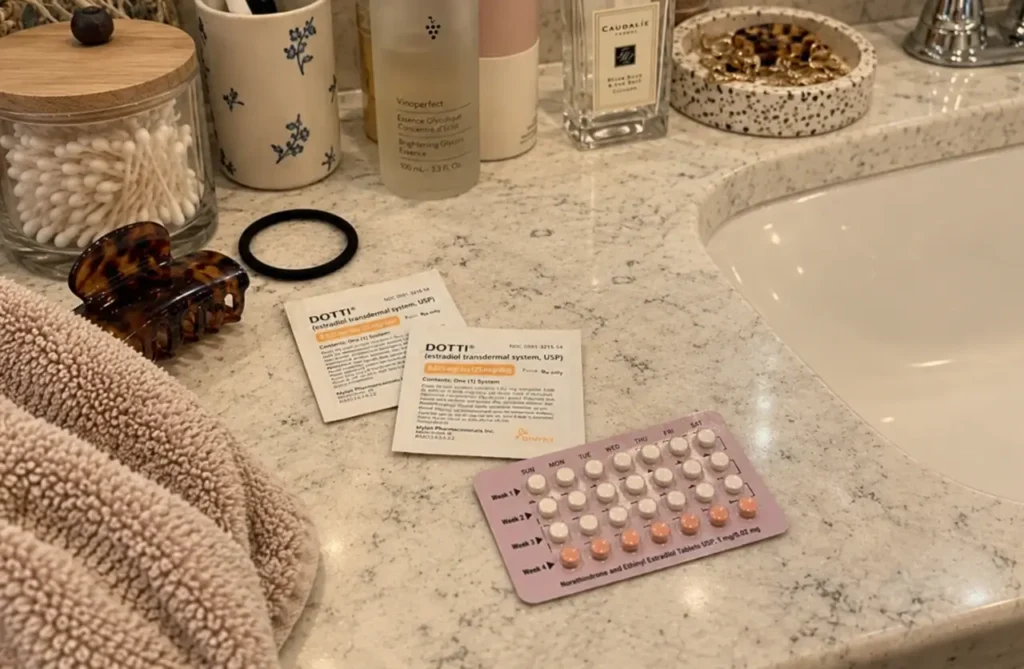
Staying on birth control or switching to menopause hormone therapy each treats these symptoms in different ways, and knowing how they compare gives you a clear place to start a conversation with your doctor.
Can birth control help with perimenopause symptoms?
Yes, and if you’re already on the pill, it may be easing some of your symptoms right now. The pill and menopause hormone therapy (often called MHT or HRT) both contain estrogen, usually paired with a progestogen, and both can help with hot flashes, night sweats, and vaginal dryness.
The difference is what each one is designed to do. The pill uses a different dose of hormones, enough to stop ovulation and prevent pregnancy. Hormone therapy uses a lower dose meant to treat symptoms and protect your bones, and it isn’t approved to prevent pregnancy.
So, the first question to ask is whether you still want to avoid pregnancy. If you do, the pill can handle both jobs.
That’s why when women come to us asking about hormone therapy, our doctors may prescribe a combined birth control pill like norethindrone acetate and ethinyl estradiol (Loestrin Fe®). For many women in their 40s, it’s the simplest way to treat symptoms and prevent pregnancy with one prescription.
Why you still need birth control in perimenopause
You can still get pregnant during perimenopause, even after going a month or several months without a period. If that’s news to you, you’re not alone. Many women are told for years that fertility ends earlier than it actually does.
Pregnancy after 44 isn’t common, but it does happen, and the CDC says anyone who wants to avoid it still needs birth control. Additionally, the Office on Women’s Health advises staying on it until a full year has passed since your last period. That’s why your doctor will look at more than which one eases symptoms better when deciding between the pill and hormone therapy: only the pill prevents pregnancy.
What staying on the pill can do in perimenopause
If you’re already taking a combined birth control pill, it may be doing more for you than preventing pregnancy. A combined pill contains two hormones: estrogen and a progestogen (progesterone or a similar hormone). During perimenopause, it can offer:
- Pregnancy prevention, which hormone therapy doesn’t provide.
- Symptom relief: Low-dose birth control may ease hot flashes, vaginal dryness, and mood swings in the years before your last period.
- Predictable bleeding: If your periods were getting heavy or erratic before you started the pill, it can keep them lighter and on schedule.
- A trade-off: Because the pill sets the timing of your bleeding, you can’t use your periods to tell how close you are to menopause.
If you’re on the pill and still having symptoms, especially during your placebo week, it’s common and worth bringing up. Your doctor will review your full medical history before deciding what’s safe for you.
What hormone therapy (HRT) can do in perimenopause
Hormone replacement therapy’s main purpose is symptom relief. The American College of Obstetricians and Gynecologists (ACOG) calls estrogen taken as a tablet or patch the most effective treatment for hot flashes and night sweats. The ACOG also adds that estrogen can ease vaginal dryness and may help protect your bones in the first years of menopause.
You don’t have to wait until your periods stop to start hormone therapy. However, while your cycle is still going, you may notice some spotting between periods.
If you still have a uterus, you’ll take progesterone or a similar hormone along with estrogen to protect your health. Estrogen on its own can thicken the lining of the uterus, and progestogen protects against that.
If safety worries have made you wary of hormone therapy, it helps to know the labels have changed. In February 2026, the FDA removed cardiovascular disease, breast cancer, and probable dementia from the boxed warning on the first six hormone therapy products to get updated labels. A boxed warning is the most serious warning a medication label can carry.
Hormone therapy still has its own risks, which your doctor will go over with you based on your health history.
If you haven’t reached menopause yet, you’re well within the FDA’s recommended window for starting hormone therapy: within 10 years of menopause, or before age 60. Hormone therapy comes as tablets, patches, gels, and vaginal forms. Our guide to menopause hormone therapy goes into more detail about how each works.
If you’re still not sure about hormone therapy, check out our guide to other menopause treatments for a look at how it compares with other options, including ones without hormones.
Birth control vs. HRT: how they compare
| Combined birth control pill | Menopause hormone therapy | |
| Main job | Preventing pregnancy | Treating menopause symptoms and helping prevent bone loss |
| Works as birth control | Yes | No |
| Type and amount of estrogen | Ethinyl estradiol, 10 to 35 micrograms (mcg) per pill, in pills such as Loestrin Fe | Estradiol tablets, 0.5 to 2 milligrams (mg), or an estradiol patch, 0.025 to 0.1 mg a day |
| Your periods | Bleeding is set by the pill, so it’s more predictable | Your own cycle continues, and spotting between periods is possible |
| Telling how close you are to menopause | Hard, since the pill sets your bleeding | Easier, since your own cycle is still showing |
| Symptom relief | Can ease hot flashes and mood swings, though symptoms may return during the placebo week | The most effective treatment for hot flashes and night sweats |
Note: The amount of estrogen in each can’t be compared directly. Ethinyl estradiol and estradiol are different forms of estrogen, so a bigger or smaller number doesn’t tell you which is stronger.
When the pill may not be a good fit after 40
After 40, your health history matters more than your age. Based on guidance from the CDC, doctors take a closer look at the pill if you have:
- High blood pressure: This counts even when medication keeps it under control.
- Blood clots: A clot in a leg or lung, whether it’s happening now or happened in the past.
- Heart disease or stroke: A history of either one.
- Migraine with aura: An aura is a warning sign before a migraine, such as flashing lights or blind spots. This applies at any age.
- Smoking, if you’re 35 or older: The pill usually isn’t recommended for smokers in this age group, and at 15 or more cigarettes a day, it isn’t considered safe. The main concern is heart attack and stroke.
- Breast cancer: Either now or in the past five years.
If you’re healthy and don’t smoke, the pill generally remains an option after 40 under the CDC’s guidance. Your doctor will review your full history before deciding what’s safe for you. If the pill isn’t a good fit, you still have options for both birth control and symptom relief, and your doctor can walk you through them.
When to talk about switching to hormone therapy
Knowing when you can stop birth control is the hard part, especially on the pill. The usual marker, 12 months in a row without a period, doesn’t work while the pill controls your bleeding. Hormone blood tests don’t solve it either. The CDC says they may not be accurate for this, and no reliable lab test can confirm that you can no longer get pregnant.
Because of this, ACOG and The Menopause Society generally recommend staying on birth control until menopause, or until somewhere between ages 50 and 55.
These are good reasons to bring up switching to hormone therapy with your doctor sooner:
- Your symptoms: Your perimenopause symptoms are getting worse, or the pill isn’t controlling them.
- Your health: Something has changed, such as new high blood pressure, that makes the pill a poorer fit.
- Your age: You’re nearing the 50 to 55 range, or going through menopause.
Switching to hormone therapy doesn’t mean giving up protection from pregnancy. Some women use a hormonal IUD to prevent pregnancy and add estrogen to treat symptoms. The hormone in the IUD also protects the lining of the uterus, so it takes the place of the progestogen you’d otherwise need.
The timing depends on your health and history, so your doctor will plan the change with you.
If heavy or irregular bleeding is the main problem
Heavy or unpredictable bleeding can wear you down, and it’s worth treating on its own.
The pill and hormone therapy can both affect bleeding, but changes like these can also come from common, treatable causes. If you’re on the pill and start bleeding between packs or more heavily than usual, let your doctor know. Our guide to heavy or irregular perimenopause bleeding covers what’s typical, when to get checked, and how it’s treated.
Frequently asked questions about birth control and HRT
Does birth control help with perimenopause anxiety and mood swings?
It may. Mood swings are one of the symptoms that low-dose birth control can reduce in the years before your last period. Anxiety can have other causes, so it’s worth raising with your doctor on its own.
Can I ask my doctor for birth control pills for perimenopause symptoms?
Yes, you can bring it up. Your doctor will check your health history, including smoking, migraines, and blood pressure, and decide whether the pill is a safe option for you.
Can I take birth control and menopause hormone therapy at the same time?
Usually not with a combined pill, since both give you estrogen. If you need birth control and your doctor recommends hormone therapy, a hormonal IUD with added estrogen is one way to cover both.
How can I tell if I’m in perimenopause while I’m on the pill?
It can be hard, since the pill controls your bleeding and no blood test settles it. Hot flashes, night sweats, or trouble sleeping can still be signs, so they’re worth mentioning to your doctor.
Will switching from the pill to hormone therapy bring my periods back?
If you haven’t reached menopause, your own cycle will likely return once you stop the pill, and it may be irregular. Hormone therapy doesn’t control your cycle, and it can cause some spotting between periods while you’re still having them.
Disclaimer
Articles on this website are meant for educational purposes only and are not intended to replace professional medical advice, diagnosis or treatment. Do not delay care because of the content on this site. If you think you are experiencing a medical emergency, please call your doctor immediately or call 911 (if within the United States). This blog and its content are the intellectual property of QuickMD LLC and may not be copied or used without permission.
References
Allergan, Inc. (2025, March 7). Lo Loestrin® Fe (norethindrone acetate and ethinyl estradiol tablets, ethinyl estradiol tablets and ferrous fumarate tablets) [Package insert]. DailyMed, U.S. National Library of Medicine. https://dailymed.nlm.nih.gov/dailymed/drugInfo.cfm?setid=c33072cf-625d-4b4a-981e-ec049c5d78aa
American College of Obstetricians and Gynecologists. (2021, October). Hormone therapy for menopause (FAQ517). https://www.acog.org/womens-health/faqs/hormone-therapy-for-menopause
Centers for Disease Control and Prevention. (2024a, November 19). U.S. medical eligibility criteria for contraceptive use, 2024: Combined hormonal contraceptives. https://www.cdc.gov/contraception/hcp/usmec/combined-hormonal-contraceptives.html
Centers for Disease Control and Prevention. (2024b, November 19). When contraceptive protection is no longer needed. In U.S. selected practice recommendations for contraceptive use, 2024. https://www.cdc.gov/contraception/hcp/usspr/contraception-not-needed.html
The Menopause Society. (2025, June 5). Perimenopause. https://menopause.org/patient-education/menopause-topics/perimenopause
Novitium Pharma LLC. (2026, July 21). Estradiol tablets, USP [Package insert]. DailyMed, U.S. National Library of Medicine. https://dailymed.nlm.nih.gov/dailymed/drugInfo.cfm?setid=5718f042-e8c0-b721-e063-6294a90a5bef
Office on Women’s Health. (2025, March 11). Menopause treatment. U.S. Department of Health and Human Services. https://womenshealth.gov/menopause/menopause-treatment
Office on Women’s Health. (2026, April 2). Menopause basics. U.S. Department of Health and Human Services. https://womenshealth.gov/menopause/menopause-basics
Teva Pharmaceuticals USA, Inc. (2021). Nortrel® (norethindrone and ethinyl estradiol tablets) [Package insert]. DailyMed, U.S. National Library of Medicine. https://dailymed.nlm.nih.gov/dailymed/drugInfo.cfm?setid=140c50d6-c931-423a-9aa0-526eae7ab93c
U.S. Food and Drug Administration. (2025, November 10). HHS advances women’s health, removes misleading FDA warnings on hormone replacement therapy [Press release]. https://www.fda.gov/news-events/press-announcements/hhs-advances-womens-health-removes-misleading-fda-warnings-hormone-replacement-therapy
U.S. Food and Drug Administration. (2026, February 12). FDA approves labeling changes to menopausal hormone therapy products [Press release]. https://www.fda.gov/news-events/press-announcements/fda-approves-labeling-changes-menopausal-hormone-therapy-products
Zydus Pharmaceuticals USA Inc. (2024, March 15). Estradiol transdermal system, USP (twice-weekly) [Package insert]. DailyMed, U.S. National Library of Medicine. https://dailymed.nlm.nih.gov/dailymed/drugInfo.cfm?setid=839fe7ae-6835-4d6a-b6b1-ca7f062caa4f
QuickMD has strict referencing policies and relies on reputable sources, including peer-reviewed research, clinical guidelines, medical organizations, and government and public health agencies, among others. Learn more about how we ensure accuracy in our content by reading our editorial guidelines.