If you’re having thoughts of suicide or self-harm, call or text 988 to reach the Suicide and Crisis Lifeline, or chat at 988lifeline.org. In an emergency, call 911.
What you’ll learn
We’ll cover why doctors often reach for an antidepressant when anxiety is the problem, and what each SSRI is approved to treat. We’ll also cover why relief takes weeks instead of days, what the first weeks on one can feel like, and how to get evaluated for one online.
You may have been told you need medication, which can bring up a lot of mixed feelings, especially when the diagnosis is anxiety and not something more visible. It’s fair to feel some doubt about it, or even relief that there’s finally a name for what you’ve been feeling. None of that means something is wrong with you, and you don’t have to sort through it by yourself.
If you’ve been offered an antidepressant for anxiety
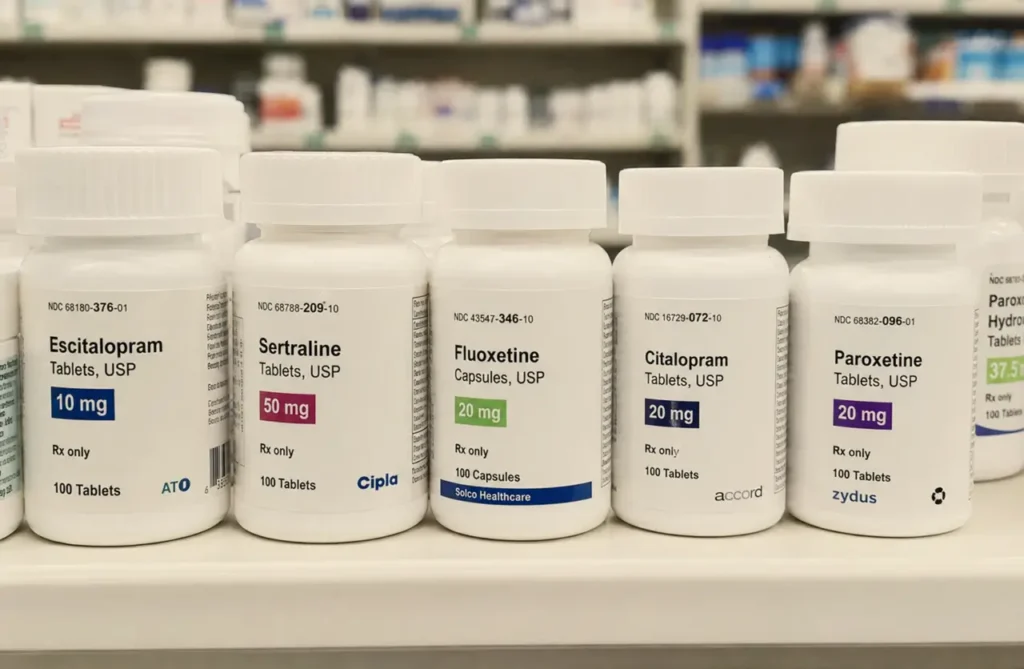
SSRIs, or selective serotonin reuptake inhibitors, are among the medications commonly used to treat generalized anxiety disorder and other anxiety disorders, including panic disorder and social anxiety disorder. It surprises a lot of people to hear that their anxiety medication is technically an antidepressant.
SSRIs sit alongside a few other classes of antidepressant medication, including serotonin and norepinephrine reuptake inhibitors (SNRIs). SSRIs are the class many doctors turn to most often for anxiety.
Clinicians often consider SSRIs a first-line option for generalized anxiety and social anxiety, as well as panic disorder. Sertraline (Zoloft®) and escitalopram (Lexapro®) are often the first ones tried. That’s a starting point, not a rule for every patient. Your doctor decides what fits your symptoms and history.
The evidence backs the approach up. A review of clinical trials found that people taking an antidepressant were about 40% more likely to respond than people taking a placebo. Researchers rated that finding as high certainty. The trials behind that number covered generalized anxiety disorder specifically, not every anxiety condition.
Medication is one part of treating anxiety, not the whole answer. Many people pair an SSRI with talk therapy, and the two often work better together than either does alone. If you want a wider view of what’s available, our guide to the full range of anxiety treatments covers therapy and other options alongside medication.
Why a medication made for depression can ease anxiety
SSRIs were originally developed to treat depression, but they help with anxiety, too, because the serotonin systems tied to mood overlap with the brain’s threat and fear response. Additionally, depression and anxiety show up together often, and it’s common to have symptoms of both at once.
Researchers found that activity in the brain region most tied to fear dropped after study participants received just one 20 mg dose of citalopram (Celexa®). It’s a small study, but it’’s still the best human evidence available for how fast an SSRI can act on the fear circuit.
That doesn’t mean SSRIs work like a sedative. They aren’t taken to calm a single moment of panic. The brain change measured in that study happens within hours. The relief a person notices takes weeks to arrive. Researchers are still working out why those two timelines don’t match, and the labels for these medications reflect that uncertainty. The labels for escitalopram and fluoxetine describe the mechanism as not fully understood, and so does paroxetine’s. Sertraline’s label states it more directly.
How long SSRIs take to work for anxiety
Antidepressants usually take four to eight weeks to work for anxiety. That’s a wide window, and where you land in it depends on your body, your dose, and what else is going on in your life. Two people starting the same medication at the same dose can have very different timelines, and that’s normal rather than a sign that something’s wrong.
The chemical change starts fast, even though the feeling doesn’t. A single dose measurably changed activity in the brain’s fear circuit within hours, in the imaging study described above. Researchers don’t fully agree on why the felt relief lags weeks behind that early change. Regardless, the wait is expected, not a warning sign.
A medication that hasn’t worked yet isn’t a medication that has failed. If four to eight weeks pass with little change, that’s a conversation to have with your doctor.
It’s fair to wonder why there isn’t something that works faster. Benzodiazepines, the medication many people associate with anxiety, work differently. The FDA requires a warning across that entire class covering physical dependence and withdrawal, because dependence can develop within several days to weeks of steady use, even when the medication is taken exactly as prescribed.
Whether one has a place in your care is a conversation for your doctor. An SSRI treats the condition itself, and the weeks of waiting are part of how that works.
What the first two weeks can be like
Some people feel more anxious, jittery, restless, or wakeful during the first week or two on an SSRI. It’s a recognized effect, not a sign the medication is wrong for you. This effect is usually temporary. If it happens to you, it can still feel unsettling, especially when you started the medication to feel less anxious in the first place.
How often this happens isn’t settled. A systematic review of published studies found that estimates vary widely from 4% to 65%, meaning no reliable figure exists. The review concluded that the jittery effect is poorly measured, with no agreed-upon way to track it.
One leading explanation is that serotonin acting early on a specific circuit in the brain can trigger a short-term fear response before the medication’s calming effects take hold.
If you feel more anxious or jittery, tell your doctor. It’s often managed with a lower starting dose or a slower increase rather than stopping the medication altogether. And if it ever feels like more than you can handle, reach out right away rather than waiting it out alone.
If you’re having thoughts of suicide or self-harm, call or text 988 to reach the Suicide and Crisis Lifeline, or chat at 988lifeline.org. In an emergency, call 911.
How to tell if it’s working
You may notice that improvement usually shows up in an order that surprises people: Sleep and appetite often get better before mood does, and concentration often follows. That pattern varies from person to person.
Track how often worry interrupts your day, how many things you’re avoiding, how your body feels physically, and how you’re sleeping. That’s the same information your doctor will ask about at a follow-up, and many use a short questionnaire called the GAD-7 to track anxiety over time. It’s a clinical tool that a doctor scores at each visit, not something meant for self-diagnosis.
A rising anxiety score early on doesn’t automatically mean the medication isn’t working. Stress, other health issues, and substance use can all move that number. A brief early increase is often just the expected first response to starting an SSRI.
If there’s been no change by the end of the four- to eight-week window, you should bring it up. Medications in the same class can differ enough that one works when another doesn’t. This is part of why it helps to see how two of them compare side by side. If two SSRIs haven’t helped, your doctor’s next step is often a medication from a different class, such as an SNRI.
What each SSRI is approved to treat
Every medication below has its own FDA-approved uses, and no two have exactly the same list. The table shows where each is approved for an anxiety-related condition, based on the current FDA labels for sertraline (Zoloft), escitalopram (Lexapro), fluoxetine (Prozac®), and paroxetine (Paxil®).
| Medication | Generalized anxiety disorder | Panic disorder | Social anxiety disorder | OCD | PTSD |
| Sertraline (Zoloft®) | Not FDA-approved | FDA-approved | FDA-approved | FDA-approved | FDA-approved |
| Escitalopram (Lexapro®) | FDA-approved | Not FDA-approved | Not FDA-approved | Not FDA-approved | Not FDA-approved |
| Fluoxetine (Prozac®) | Not FDA-approved | FDA-approved | Not FDA-approved | FDA-approved | Not FDA-approved |
| Paroxetine (Paxil®) | FDA-approved | FDA-approved | FDA-approved | FDA-approved | FDA-approved |
“Not FDA-approved” doesn’t mean unsafe or unstudied. It means the manufacturer never ran the specific trials needed to add that condition to the label. Once the FDA approves a medication for anything, doctors may prescribe it for another use when they judge it appropriate for a specific patient. That’s called off-label prescribing, and it’s very common.
Sertraline (Zoloft®) for anxiety is often prescribed off-label, since generalized anxiety disorder isn’t on its FDA label. Sertraline’s uses and dosages are well-documented.
Paroxetine (Paxil®) is the only one of these four approved for all five conditions in adults. That’s a fact about its label, not a reason to prefer it. Paroxetine usually isn’t a first choice because of its side-effect profile, while sertraline and escitalopram are often tried first. Escitalopram is also used off-label for premenstrual dysphoric disorder (“blues”).
Your doctor will decide what makes the most sense for you.
Starting doses, and why anxiety often starts lower
For anxiety, and panic disorder especially, doctors often start at a lower dose than they would for depression, then increase it slowly. A gentler start can ease the early jitteriness that leads some people to quit too soon.
| Medication | Typical starting dose for anxiety, per label |
| Sertraline (Zoloft®) | 25 mg/day for panic disorder, PTSD, and social anxiety disorder |
| Escitalopram (Lexapro®) | 10 mg/day for its approved use |
| Fluoxetine (Prozac®) | 10 mg/day, increasing to 20 mg after one week, for panic disorder |
| Paroxetine (Paxil®) | 10 mg/day for panic disorder; 20 mg/day for its other approved uses |
Some clinicians may go lower still for panic disorder and social anxiety disorder: 12.5 mg of sertraline for the first week, then 25 mg, increasing in 25 to 50 mg increments as needed to a maximum of 200 mg. The reasoning is the same as the one above: A slower start can mean an easier first few weeks. Doses are set and adjusted by your doctor. Don’t change your own dose without talking to them first.
If your diagnosis is OCD or PTSD
OCD and PTSD are no longer grouped with the anxiety disorders in current diagnostic manuals, but SSRIs are still used to treat both.
For OCD, treatment can take longer to show results. According to the National Institute of Mental Health (NIMH), antidepressant treatment for OCD can take eight to 12 weeks before symptoms start to improve, longer than the four- to eight-week window for anxiety disorders. OCD sometimes calls for higher doses than depression typically requires.
Sertraline (Zoloft®) and fluoxetine (Prozac®) carry FDA approval for OCD, and so does paroxetine (Paxil®).
For PTSD, NIMH describes the main treatments as talk therapy, medication, or a combination of the two, and notes that a doctor may prescribe an SSRI alongside therapy. Sertraline and paroxetine both carry FDA approval for PTSD.
We don’t treat chronic or complex psychiatric conditions. If OCD or PTSD is your diagnosis, our page on care for more complex mental health conditions can help you find the right specialty care.
Side effects and what the FDA labels show
Common early effects reported on the escitalopram label include nausea, headache, trouble sleeping or drowsiness, dry mouth, diarrhea, sweating, tremor, and reduced appetite. Most ease over the first few weeks. Any of these can happen, but none is guaranteed.
Weight can shift, too, though usually not by much. In a large study using medical records, people taking escitalopram gained about 0.4 kg (a little under a pound) more than people taking sertraline over six months.
Sexual side effects. SSRIs can involve a lower sex drive or difficulty reaching orgasm. It’s worth raising with your doctor rather than living with it quietly. A dose change or a different medication can sometimes help.
Feeling emotionally flat. Some people describe feeling less reactive or emotionally dulled on an SSRI. The escitalopram label lists apathy only as a post-marketing report, without a specific rate attached. So, this isn’t a common, well-measured effect like nausea or a headache.
The boxed warning. All four medications covered here carry the same FDA boxed warning, which is the FDA’s strongest safety alert. It warns about an increased risk of suicidal thoughts and behavior in people under 25. The labels describe this risk as highest in the first months of treatment and around the time of a dose change, a wider window than the first weeks covered above.
If you’re having thoughts of suicide or self-harm, call or text 988 to reach the Suicide and Crisis Lifeline, or chat at 988lifeline.org. In an emergency, call 911.
If you’re thinking about stopping an SSRI
Stopping an SSRI abruptly can bring on discontinuation symptoms, so it’s typically tapered down with a doctor’s guidance rather than stopped outright. Those symptoms can include dizziness, headache, tiredness, nausea, sweating, irritability, anxiety, trouble sleeping, unusual dreams, and numbness or tingling.
Discontinuation symptoms and a return of the original anxiety are easy to confuse, and they’re handled differently. The table below shows the general pattern, though your doctor is best placed to tell the two apart in your specific case.
| Discontinuation symptoms | Returning anxiety | |
| Timing | Usually start within days to weeks of stopping or lowering the dose | Tends to build later |
| What it feels like | Often includes physical symptoms that weren’t part of the original anxiety | Looks like the original condition returning |
| What happens next | Eases as the body adjusts | May call for restarting or adjusting treatment |
How long a medication takes to clear the body helps explain why this experience varies between medications. Paroxetine clears the body in roughly four days, while fluoxetine takes about 25. A taper schedule is something your doctor plans and adjusts with you.
How an online visit works
A psychiatrist isn’t required to start an SSRI. Licensed clinicians, including primary care doctors, commonly prescribe them. Through our online mental health care visits a doctor can evaluate your symptoms and determine whether an SSRI is appropriate. SSRIs are not federally controlled substances, making them an option for treatment through telemedicine.
We have doctors in 44+ states and Washington, D.C., with visits often available the same day, seven days a week. You don’t need insurance, and a mental health visit costs $99.
Whatever’s kept you from having this conversation so far, a licensed doctor can see you for anxiety and meet you exactly where you are, without judgment, whenever you’re ready.
Frequently asked questions about SSRIs for anxiety
How long will I need to take an SSRI?
That’s decided with your doctor, and it depends on your condition and how you respond. Research doesn’t offer a firm timeline either: The largest review of these medications for anxiety followed people for four to 28 weeks, not years.
Are SSRIs addictive?
No. SSRIs aren’t Schedule IV controlled substances (medications with some risk of physical or psychological dependence) and don’t carry that risk. However, stopping one abruptly can still cause discontinuation symptoms, covered above. Our doctors don’t prescribe benzodiazepines like Xanax®, Valium®, Ativan®, or Klonopin®, which are Schedule IV controlled substances.
Can I take an SSRI only when I feel anxious, rather than every day?
No. SSRIs are daily medications taken continuously, not something used as needed before a stressful moment. That’s a real difference from how some people picture anxiety medication working. If your anxiety only flares in specific situations, that’s worth raising with a doctor directly.
What happens if I miss a dose?
In general, take the missed dose as soon as you remember, unless it’s almost time for your next one. Never take a double dose to make up for it. Your doctor or pharmacist can advise on your specific medication.
Do I need a diagnosis before I can be prescribed an SSRI?
No. Our doctors evaluate your symptoms and history during the visit itself. You don’t need to arrive with a diagnosis already in hand.
What if the first SSRI doesn’t help?
Trying a different one is normal and expected. If two SSRIs haven’t worked, the next step your doctor considers is often a medication from a different class, such as an SNRI. See “How to tell if it’s working” above for what to track in the meantime.
Disclaimer
Articles on this website are meant for educational purposes only and are not intended to replace professional medical advice, diagnosis or treatment. Do not delay care because of the content on this site. If you think you are experiencing a medical emergency, please call your doctor immediately or call 911 (if within the United States). This blog and its content are the intellectual property of QuickMD LLC and may not be copied or used without permission.
References
Kopcalic K, Arcaro J, Pinto A, et al. Antidepressants versus placebo for generalised anxiety disorder. Cochrane Database Syst Rev. 2025;(1):CD012942. doi:10.1002/14651858.CD012942.pub2. https://www.cochrane.org/evidence/CD012942_antidepressants-generalised-anxiety-disorder
National Institute of Mental Health. Generalized Anxiety Disorder: When Worry Gets Out of Control. Bethesda (MD): National Institute of Mental Health. https://www.nimh.nih.gov/health/publications/generalized-anxiety-disorder-gad
Sertraline (Zoloft®) prescribing information. Bethesda (MD): DailyMed, National Library of Medicine. https://dailymed.nlm.nih.gov/dailymed/drugInfo.cfm?setid=fda754f6-d0f3-4dce-a17a-927d64f912f7
Escitalopram (Lexapro®) prescribing information. Bethesda (MD): DailyMed, National Library of Medicine. https://dailymed.nlm.nih.gov/dailymed/drugInfo.cfm?setid=13bb8267-1cab-43e5-acae-55a4d957630a
Fluoxetine (Prozac®) prescribing information. Bethesda (MD): DailyMed, National Library of Medicine. https://dailymed.nlm.nih.gov/dailymed/drugInfo.cfm?setid=c88f33ed-6dfb-4c5e-bc01-d8e36dd97299
Paroxetine (Paxil®) prescribing information. Bethesda (MD): DailyMed, National Library of Medicine. https://dailymed.nlm.nih.gov/dailymed/drugInfo.cfm?setid=ef3b5cbe-f9e1-c1ac-79da-cfe14e3a7e7e
U.S. Food and Drug Administration. Understanding Unapproved Use of Approved Drugs “Off Label.” https://www.fda.gov/patients/learn-about-expanded-access-and-other-treatment-options/understanding-unapproved-use-approved-drugs-label
Sinclair LI, Christmas DM, Hood SD, et al. Antidepressant-induced jitteriness/anxiety syndrome: systematic review. Br J Psychiatry. 2009;194(6):483-490. https://pubmed.ncbi.nlm.nih.gov/19478285/
Murphy SE, Norbury R, O’Sullivan U, Cowen PJ, Harmer CJ. Effect of a single dose of citalopram on amygdala response to emotional faces. Br J Psychiatry. 2009;194(6):535-540. https://www.cambridge.org/core/journals/the-british-journal-of-psychiatry/article/effect-of-a-single-dose-of-citalopram-on-amygdala-response-to-emotional-faces/15E316EDC7DCC79839342E782A2E1D4B
Marcinkiewcz CA, Mazzone CM, D’Agostino G, et al. Serotonin engages an anxiety and fear-promoting circuit in the extended amygdala. Nature. 2016;537(7618):97-101. https://www.nature.com/articles/nature19318
U.S. Food and Drug Administration. FDA Requiring Boxed Warning Updated to Improve Safe Use of Benzodiazepine Drug Class. 2020 Sep 23. https://www.fda.gov/drugs/drug-safety-and-availability/fda-requiring-boxed-warning-updated-improve-safe-use-benzodiazepine-drug-class
U.S. Drug Enforcement Administration, Diversion Control Division. Controlled Substances, Alphabetical Order. https://www.deadiversion.usdoj.gov/schedules/orangebook/c_cs_alpha.pdf
National Institute of Mental Health. Mental Health Medications. https://www.nimh.nih.gov/health/topics/mental-health-medications
National Institute of Mental Health. Obsessive-Compulsive Disorder: When Unwanted Thoughts Take Over. https://www.nimh.nih.gov/health/publications/obsessive-compulsive-disorder-when-unwanted-thoughts-take-over
National Institute of Mental Health. Post-Traumatic Stress Disorder. https://www.nimh.nih.gov/health/publications/post-traumatic-stress-disorder-ptsd
Paroxetine. Bethesda (MD): MedlinePlus, National Library of Medicine. https://medlineplus.gov/druginfo/meds/a698032.html
Going off antidepressants. Boston (MA): Harvard Health Publishing. https://www.health.harvard.edu/diseases-and-conditions/going-off-antidepressants
Petimar J, Young JG, Yu H, et al. Medication-induced weight change across common antidepressant treatments. Ann Intern Med. 2024;177(8):993-1003. https://doi.org/10.7326/M23-2742
QuickMD has strict referencing policies and relies on reputable sources, including peer-reviewed research, clinical guidelines, medical organizations, and government and public health agencies, among others. Learn more about how we ensure accuracy in our content by reading our editorial guidelines.