What you’ll learn
We’ll cover what fluoxetine (Prozac®) treats, why it’s also used for anxiety, how it works, typical dosing, and what the first several weeks tend to feel like. By the end, you’ll have a clear sense of what to expect.
Fluoxetine might not sound familiar, but Prozac, its original brand name, probably does. This medication has been prescribed and studied for decades, so starting it doesn’t mean stepping into the unknown. Whatever questions you have, we’re here to walk through them with you.
What is fluoxetine (Prozac)?
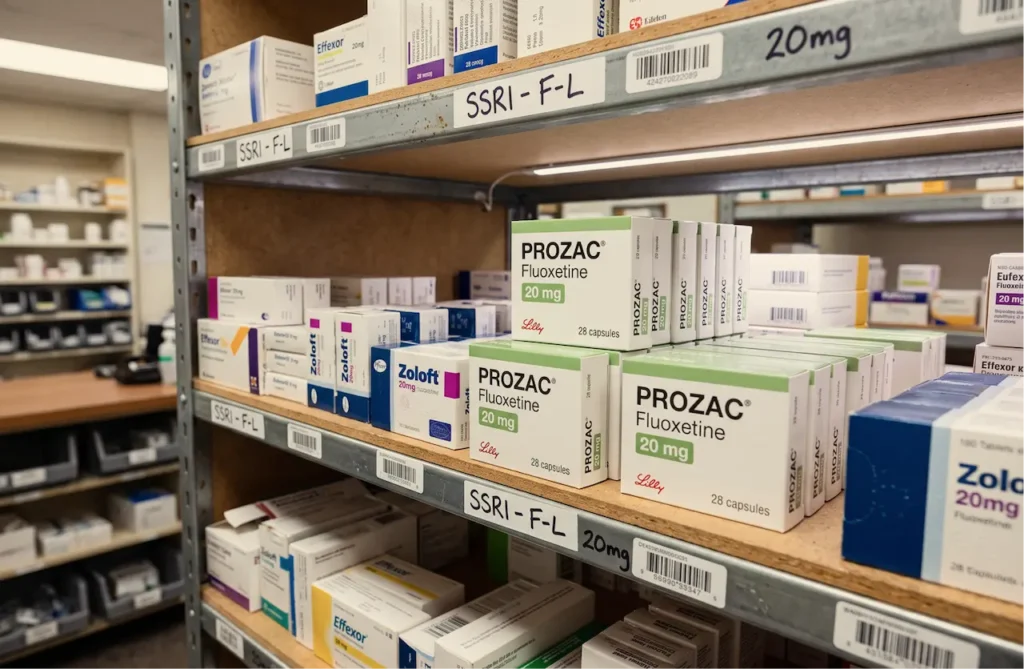
Fluoxetine (Prozac) is a prescription antidepressant. It belongs to a medication class called SSRIs, or selective serotonin reuptake inhibitors, one of the most commonly prescribed types of antidepressants.
Prozac is the original brand name; fluoxetine is the generic. They have the same active ingredient, and the generic version is less expensive and widely available. The FDA first approved it in the late 1980s, and it’s remained one of the most prescribed antidepressants ever since.
Fluoxetine has been in use long enough that its side effects and risks are well documented. Your doctor knows what to expect from it.
A few quick facts worth knowing:
- Fluoxetine is taken by mouth, most often once daily in the morning, as a capsule, tablet, or liquid. A once-weekly delayed-release formulation is also available, but only for patients already stable on a daily dose.
- It isn’t a controlled substance and isn’t considered addictive. Even so, don’t stop fluoxetine suddenly on your own; more on why further down.
What is fluoxetine (Prozac) used for?
Fluoxetine is FDA-approved to treat several conditions:
- Major depressive disorder (depression)
- Obsessive-compulsive disorder (OCD)
- Bulimia nervosa
- Panic disorder
It’s also FDA-approved in combination with olanzapine, an antipsychotic medication, for depressive episodes tied to bipolar I disorder, and for depression that hasn’t responded to other treatment. Fluoxetine (Prozac) isn’t prescribed alone for bipolar disorder.
In children and teens, fluoxetine (Prozac) is FDA-approved for depression starting at age 8, and for OCD starting at age 7, a broader approval range than most other SSRIs. If you’re looking into this for a child or teen, our doctors evaluate and prescribe for adults only.
Why is fluoxetine (Prozac) prescribed for anxiety, too?
Panic disorder, one of fluoxetine’s FDA-approved uses, is itself an anxiety-related condition. Doctors also prescribe fluoxetine (Prozac) off-label for generalized anxiety disorder (GAD), along with other anxiety-related conditions.
How does fluoxetine (Prozac) work, and why does its long half-life matter?
As an SSRI, fluoxetine (Prozac) slows your brain’s ability to reabsorb serotonin (a chemical messenger involved in regulating mood and anxiety), leaving more of it available. This is thought to improve mood and ease anxiety over time. The full picture is more complex, but raising serotonin levels is a meaningful part of how fluoxetine (Prozac) helps.
Fluoxetine (Prozac) also has one of the longest half-lives of any commonly used antidepressant. Because of that, a dose change takes longer to fully show up in your system than it would with most other antidepressants.
The exact number varies depending on the source you read, but it’s roughly:
- 1 to 6 days for fluoxetine (Prozac) itself
- 4 to 16 days for its active byproduct, norfluoxetine
Missing an occasional dose is less likely to cause the withdrawal-type symptoms some people get with a shorter-acting antidepressant. Stopping fluoxetine (Prozac) may involve milder discontinuation effects, since the medication tapers itself somewhat on its way out of your system.
Fluoxetine (Prozac) dosage: typical ranges
The ranges below are typical starting points for adults.
| Condition | Typical starting dose | Typical maintenance range |
| Depression | 20 mg once daily, in the morning | 20 to 80 mg daily |
| OCD | 20 mg daily | 20 to 60 mg daily |
| Bulimia nervosa | 60 mg once daily | 60 mg once daily |
| Panic disorder | 10 mg daily | 20 to 60 mg daily |
| Bipolar depression (with olanzapine, doctor-set) | Fluoxetine 20 mg with olanzapine 5 mg | Fluoxetine 20 to 50 mg with olanzapine 5 to 12.5 mg |
SOURCE: FDA
Fluoxetine (Prozac) is usually taken in the morning. It can be more energizing than other SSRIs, so taking it later in the day may interfere with falling asleep at night.
Notice how much the ranges vary by condition: bulimia nervosa is typically treated at a single, fixed dose, while depression covers a much wider range. This is why your doctor sets your exact dose based on your diagnosis and your body’s response, then adjusts it as needed.
What to expect in the first 4 to 6 weeks
Some early changes can show up quickly:
- Sleep, appetite, and energy can change within the first two weeks. A few people also feel a bit more alert, restless, or wired at first, which usually settles as the body adjusts.
- Mood improvement usually takes longer than the other changes. Most people notice something around the 4-week mark, with the full benefit taking 6 to 8 weeks to build. Give it that much time before deciding it isn’t working.
- If side effects show up before benefits do, it’s not a sign that something’s wrong. Tell your doctor if anything feels severe, or if nothing has changed after several weeks.
Keeping a rough note of how you’re feeling week to week can make follow-up appointments more useful. It’s easy to forget small changes about sleep, appetite, mood, or energy once they’ve become the new normal.
What to know before you start
Don’t stop fluoxetine (Prozac) on your own. Even with its gentler discontinuation profile, any change or stop should be monitored by your doctor. Getting off any antidepressant works best with a plan rather than a single decision made on a challenging day.
Antidepressants can raise the risk of suicidal thoughts and behavior in children, teens, and young adults under 25. The risk is highest in the first few weeks of treatment and after a dose change. Studies have not found the same risk in adults over 25.
This is why your doctor will want to hear from you early rather than at your next scheduled visit. If you are under 25, or you are keeping an eye on a younger person taking fluoxetine (Prozac), tell your doctor about new or worsening mood, restlessness or agitation, or any talk of self-harm. These are reasons to contact them, not things to work out on your own.
Doctors still prescribe fluoxetine (Prozac) to this age group, because untreated depression carries its own risks. This warning is about watching closely in the first weeks, not about avoiding the medication.
If you are having thoughts of suicide or self-harm, call or text the 988 Suicide and Crisis Lifeline, or chat at 988lifeline.org. In an emergency, call 911.
Tell your doctor about every other medication and supplement you take, especially anything that affects serotonin. Also, flag any MAOIs (monoamine oxidase inhibitors, an older class of antidepressants) you take, and any personal or family history of bipolar disorder. Fluoxetine (Prozac) can change how your body processes other medications, even ones that seem unrelated, like over-the-counter pain relievers or herbal supplements.
How to get a fluoxetine (Prozac) prescription online
Getting a fluoxetine (Prozac) prescription through QuickMD usually takes three steps.
- Book a mental health visit. Pick a time and meet with a licensed doctor by phone or video.
- Talk through your symptoms. Your doctor will ask what you have been experiencing, what other medications and supplements you take, and whether you have tried treatment before.
- Fill your prescription. If your doctor decides fluoxetine (Prozac) is appropriate, they send it to the pharmacy you choose or, if eligible, can send your medication directly to your door through QuickMD Home Delivery.
Plan on a follow-up visit. Your dose is sometimes adjusted over the first several weeks as your doctor sees how you are responding.
Our doctors are licensed in 40+ states. Whether fluoxetine (Prozac) is right for you is your doctor’s decision, not something we promise up front. Our fluoxetine prescription page covers what the visit looks like.
Frequently asked questions about fluoxetine (Prozac)
Prozac (fluoxetine) vs. Zoloft (sertraline): what’s the difference?
Both are SSRIs, but they behave differently in your body. Fluoxetine (Prozac) stays in your system much longer and tends to be more activating, while sertraline (Zoloft) clears out faster. Neither is inherently stronger; the real differences show up more in how each is absorbed and metabolized than in how well either treats depression or anxiety. Which one fits depends on your specific diagnosis and history, a decision your doctor makes with you.
Is fluoxetine the same as Xanax®?
No. Fluoxetine (Prozac) is an SSRI antidepressant, while Xanax is a benzodiazepine and a controlled substance. The two also work differently: Xanax acts quickly for short-term anxiety relief, but fluoxetine (Prozac) is taken daily and builds its full effect over several weeks.
Does fluoxetine cause weight gain?
It can, though effects vary by person, the same as with any antidepressant. It isn’t one of the more common reasons people stop taking it, but it’s still worth mentioning to your doctor if you notice a real shift either way. Your doctor can keep an eye on it with you and help manage any changes.
Can I drink alcohol while taking fluoxetine?
Check with your doctor first. Alcohol can make some side effects worse and is generally discouraged alongside antidepressants. It can also make it harder to tell whether something you’re feeling is from the medication, the alcohol, or an interaction between the two.
Disclaimer
Articles on this website are meant for educational purposes only and are not intended to replace professional medical advice, diagnosis or treatment. Do not delay care because of the content on this site. If you think you are experiencing a medical emergency, please call your doctor immediately or call 911 (if within the United States). This blog and its content are the intellectual property of QuickMD LLC and may not be copied or used without permission.
References
US Food and Drug Administration. Fluoxetine (Prozac) Prescribing Information. accessdata.fda.gov. 2017. accessdata.fda.gov
US National Library of Medicine. Fluoxetine: MedlinePlus Drug Information. medlineplus.gov. medlineplus.gov
National Institute of Mental Health. Mental Health Medications. nimh.nih.gov. nimh.nih.gov
Fluoxetine. In: StatPearls. NCBI Bookshelf. ncbi.nlm.nih.gov. ncbi.nlm.nih.gov
988 Suicide and Crisis Lifeline. 988lifeline.org. 988lifeline.org
American Psychiatric Association. Focus: Pharmacotherapy for Generalized Anxiety Disorder. psychiatryonline.org. doi:10.1176/appi.focus.20200048. psychiatryonline.org
QuickMD has strict referencing policies and relies on reputable sources, including peer-reviewed research, clinical guidelines, medical organizations, and government and public health agencies, among others. Learn more about how we ensure accuracy in our content by reading our editorial guidelines.