What you’ll learn
We’ll cover what duloxetine (Cymbalta®) is, why it’s an SNRI rather than an SSRI, and why the same medication treats mood and pain. We’ll also explain how it’s dosed, how long it takes to work, cost, side effects, and how to stop it safely.
Has your doctor brought up duloxetine (Cymbalta®)? Or have you come across the name and want to know more? It’s used to treat depression and anxiety, and it can also help when pain comes along with them. Whatever brought you here, it’s normal to have questions about a medication before you start it, and asking them is a good first step.
What is duloxetine, and what is it used for?
Doctors prescribe duloxetine (the generic name for Cymbalta®) to treat depression and anxiety. It can also help with some long-lasting pain.
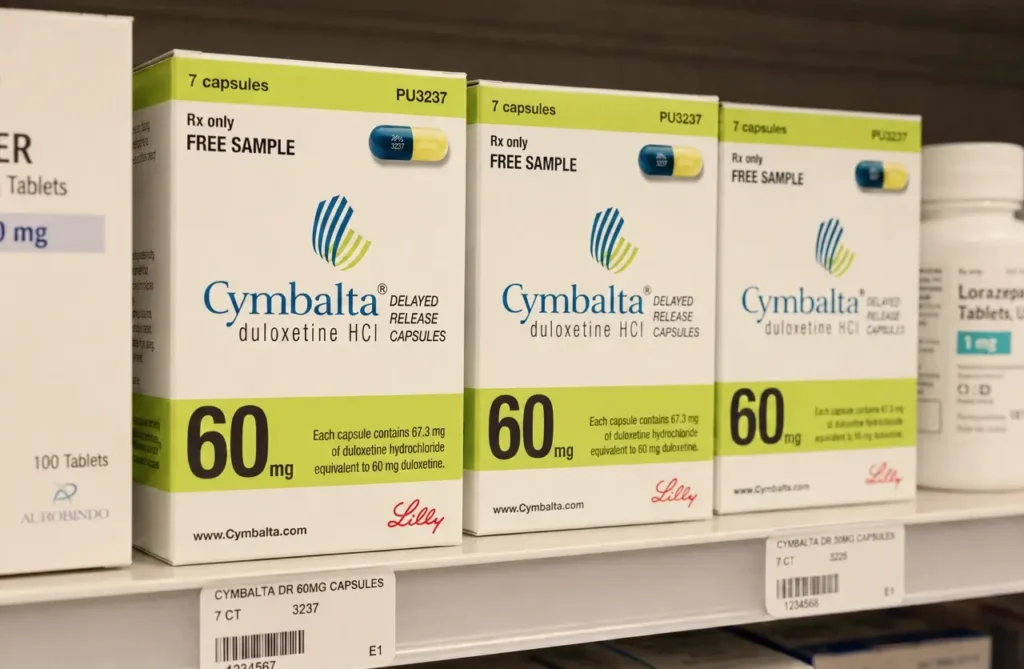
It’s an SNRI, a serotonin-norepinephrine reuptake inhibitor, not an SSRI. An SSRI works on one chemical messenger in the brain, serotonin, while an SNRI works on two: serotonin and norepinephrine. That’s the heart of how SSRIs and SNRIs differ. It comes as delayed-release capsules in 20 mg, 30 mg, and 60 mg strengths.
The FDA-approved duloxetine (Cymbalta) uses are:
- Major depressive disorder in adults
- Generalized anxiety disorder in adults and in children 7 and older (QuickMD doesn’t treat anyone under 18)
- Diabetic peripheral neuropathic pain in adults
- Fibromyalgia in adults and adolescents 13 and older
- Chronic musculoskeletal pain in adults
Doctors also prescribe duloxetine (Cymbalta) off-label for other conditions from time to time, which is common. If someone has tried two SSRIs for depression or anxiety and they haven’t worked, doctors often look at an SNRI like duloxetine (Cymbalta) next.
Why duloxetine treats mood and pain
It may sound strange to you when your doctor hands you an antidepressant to treat pain. But understanding the connection can make it all make sense.
Your body has its own built-in system for turning down pain before it reaches you, on a pathway that runs from the brain down into the spinal cord. Serotonin and norepinephrine are two of the chemicals that the system uses to send its signal. Research on duloxetine (Cymbalta) describes it as strengthening the activity of that pathway, right where pain signals enter the spinal cord. So, the body’s own pain-dampening message comes through more clearly.
That’s why duloxetine (Cymbalta) for pain is a real, separate use rather than a side benefit of the antidepressant effect. Duloxetine (Cymbalta) handles mood and pain through different parts of the same action, which is why pain can ease in someone who isn’t depressed, and mood can lift in someone who only wanted pain relief. Neither one is a side effect of the other. Duloxetine (Cymbalta) also raises dopamine in a part of the brain tied to mood regulation, which plays a role in how it works there, too.
Duloxetine dosage: how much, and why it changes by condition
Because duloxetine (Cymbalta) treats different conditions, the starting, usual, and maximum doses aren’t the same for all of them. If you’re taking it for diabetic nerve pain, you’ll notice this table looks different from a friend’s prescription for anxiety, and that’s expected.
| Condition | Starting dose | Usual dose | Maximum dose |
| Major depressive disorder (adults) | 40–60 mg | 40–60 mg | 120 mg |
| Generalized anxiety disorder, adults under 65 | 60 mg | 60 mg | 120 mg |
| Generalized anxiety disorder, adults 65 and older | 30 mg^ | 60 mg | 120 mg |
| Generalized anxiety disorder, ages 7–17* | 30 mg | 30–60 mg | 120 mg† |
| Diabetic peripheral neuropathic pain (adults)* | 60 mg | 60 mg | 60 mg |
| Fibromyalgia, adults and ages 13–17* | 30 mg | 60 mg | 60 mg |
| Chronic musculoskeletal pain (adults)* | 30 mg | 60 mg | 60 mg |
*This row reflects the FDA label rather than a service QuickMD offers directly. We don’t treat anyone under 18, and the standalone pain conditions listed here aren’t conditions we treat on their own.
†120 mg was the highest dose studied in children with generalized anxiety disorder. It’s a ceiling from the research, not a target dose.
^For anxiety in patients 65+, the label directs 30 mg once daily for two weeks (not one) before considering 60 mg.
The highest dose isn’t the same for every condition. Depression and anxiety can go up to 120 mg a day, while the three pain conditions stop at 60 mg.
For depression and anxiety, the only uses where the label allows more than 60 mg, you may wonder if a higher dose helps more. The label says 120 mg a day has been shown to work, but there’s no evidence that more than 60 mg a day provides additional benefit. Some experts report seeing benefits above 60 mg. This isn’t settled, and it’s a question for your doctor.
Our doctors may start duloxetine (Cymbalta) at 30 mg for one week, then increase to 60 mg if needed, with 120 mg as the highest dose if needed. That fits what the label allows for adults under 65, which permits a 30 mg start for the first week if side effects are a concern.
Take the capsules with or without food. Swallow them whole. Don’t open, split, chew, or crush them, because the coating protects the medication from stomach acid.
Your doctor sets your dose. These numbers describe what the label allows, not a plan to follow on your own.
How long duloxetine takes to work
It can take anywhere from one to four weeks, sometimes longer, before you feel the full benefit. That timeline holds true for mood and for pain alike. Some side effects can start before you feel any benefit, so nausea or tiredness in the first few days doesn’t mean it isn’t working. Give it time, and talk to your doctor rather than stopping on your own if it doesn’t feel right.
Duloxetine side effects
Side effects with duloxetine (Cymbalta) are common and usually mild, tending to appear early rather than build over time. This holds true whichever condition you’re taking duloxetine (Cymbalta) for. The effects below may show up, though most people don’t get all of them, and most ease as your body adjusts.
Common side effects
These rates come from studies comparing duloxetine (Cymbalta) with a placebo.
| Side effect | Duloxetine (Cymbalta) | Placebo |
| Nausea | 23% | 8% |
| Dry mouth | 13% | 5% |
| Drowsiness | 10% | 3% |
| Constipation | 9% | 4% |
| Decreased appetite | 7% | 2% |
| Sweating | 6% | 1% |
Nausea is the most common effect. It often eases as your body adjusts, which is part of why some doctors start at 30 mg for the first week. If nausea doesn’t ease, tell your doctor rather than stopping on your own.
After six months, people on duloxetine (Cymbalta) gained about three-quarters of a pound more than people on sertraline (Zoloft®). That’s how much more they gained compared with the sertraline (Zoloft) group, not their total weight gain, and it comes from the records of over 180,000 patients rather than a trial. Lower appetite is also common at first, so some people may lose a little weight early on.
Sexual side effects happen occasionally, and they’re a common reason people wish to stop treatment. Reported rates include erectile dysfunction at 4% versus 1% on placebo, decreased libido at 3% versus 1%, delayed ejaculation at 2% versus 1%, and difficulty reaching orgasm at 2% versus under 1%. If any of these show up for you, bring it up with your doctor. There are often ways to adjust the plan.
Duloxetine (Cymbalta) can also slightly raise blood pressure. It’s why your doctor checks your blood pressure before you start and periodically afterward.
Serious side effects and the boxed warning
If you’re having thoughts of suicide or self-harm, call or text 988 to reach the Suicide and Crisis Lifeline, or chat at 988lifeline.org. In an emergency, call 911.
Serious liver problems are uncommon, but in rare cases duloxetine (Cymbalta) can lead to liver failure, which can be life-threatening. If your skin or eyes turn yellow, call your doctor or go to the nearest emergency room. The label advises against duloxetine (Cymbalta) for people who drink heavily or have long-term liver disease, so tell your doctor about either before you start.
A few other effects call for a conversation with your doctor:
- A rare but serious reaction called serotonin syndrome, which is more likely if you take duloxetine (Cymbalta) alongside another medication that also raises serotonin levels
- Mood or behavior that shifts in a way that feels out of character for you
- New eye pain or blurred vision, a possible sign that duloxetine (Cymbalta) may be making a form of glaucoma worse
- A drop in sodium levels, which can look like sudden confusion or an unexpected fall, most often in older adults
- Bruising or bleeding more easily than usual, worth extra attention if you also take a blood thinner or a regular anti-inflammatory pain reliever
As with every antidepressant, duloxetine (Cymbalta) carries a boxed warning. In short-term studies, antidepressants raised the risk of suicidal thoughts and behaviors in children, teens, and young adults under 25. The same studies found no added risk in adults over 24, and a lower risk in adults 65 and older. If you or someone you love starts duloxetine (Cymbalta), watch for worsening mood or new thoughts of self-harm, and tell your doctor right away. This applies to whatever it was prescribed for.
Call your doctor about any of the effects above. Call 911, or go to the nearest emergency room, for thoughts of self-harm, signs of an allergic reaction, or any symptom that feels severe or sudden.
Stopping duloxetine
The label recommends lowering the dose gradually, under your doctor’s guidance, rather than stopping all at once. Your body clears duloxetine (Cymbalta) fast. Every 12 hours, about half of what’s left is gone, and most of it is out of your body in two and a half days. That means levels drop quickly when you stop, and your body has less time to adjust. One source rates duloxetine (Cymbalta) as a moderate risk for symptoms when stopping, and places venlafaxine (Effexor XR®) and desvenlafaxine (Pristiq®) in a higher-risk group. That’s one source’s grouping rather than a head-to-head study.
Symptoms that can show up if you stop duloxetine (Cymbalta) too quickly include:
- Dizziness or headache
- Nausea, diarrhea, or vomiting
- A tingling or pins-and-needles feeling
- Irritability or anxiety
- Trouble sleeping
- Sweating and fatigue
Duloxetine (Cymbalta)isn’t a medication to stop on your own. If you want to change your dose or come off it, a follow-up visit with your doctor is the way to do it. If you’ve missed doses and feel unwell, tell your doctor rather than waiting it out.
Who should not take duloxetine
Some medications don’t mix safely with duloxetine (Cymbalta). The main one is an MAOI (monoamine oxidase inhibitor), an older type of antidepressant. You shouldn’t take duloxetine (Cymbalta) if you take an MAOI now or took one in the past 14 days. After you stop, wait at least 5 days before you start an MAOI. Two other medications act like an MAOI in your body. One is the antibiotic linezolid (Zyvox®). The other is methylene blue (ProvayBlue®) given through an IV. You shouldn’t start duloxetine (Cymbalta) while taking either one.
Some health conditions need extra care. They don’t always rule duloxetine (Cymbalta) out, but your doctor will weigh them first. The label advises against it if you drink heavily or have long-term liver disease, including cirrhosis (scarring of the liver). It also advises against it if you have severe kidney disease. Tell your doctor if you have high blood pressure or glaucoma. Also tell them if you have narrow angles in your eye, a shape that can raise the risk of glaucoma. If you’re pregnant or breastfeeding, that’s a decision to make with your doctor.
Give your doctor a full list of everything you take, including pain relievers, blood thinners, and supplements. That way, they can check for anything that doesn’t mix.
Frequently asked questions about duloxetine (Cymbalta®)
Is duloxetine a painkiller?
Not in the way most people mean that word. Duloxetine (Cymbalta) isn’t an opioid and isn’t an anti-inflammatory, and it doesn’t act at the site of an injury. It’s approved for specific pain conditions and works instead through the nervous system’s own pain pathways.
Can you drink alcohol while taking duloxetine?
You should avoid alcohol use, especially heavy alcohol use, with duloxetine (Cymbalta) because of the liver risk covered above. There’s no confirmed safe number of drinks, so talk with your doctor about what’s appropriate for you.
What happens if you miss a dose of duloxetine?
Take it as soon as you remember. If it’s almost time for your next dose, skip the missed one and continue as scheduled. Don’t take two doses at once.
Disclaimer
Articles on this website are meant for educational purposes only and are not intended to replace professional medical advice, diagnosis or treatment. Do not delay care because of the content on this site. If you think you are experiencing a medical emergency, please call your doctor immediately or call 911 (if within the United States). This blog and its content are the intellectual property of QuickMD LLC and may not be copied or used without permission.
References
CYMBALTA (duloxetine) delayed-release capsules [prescribing information]. DailyMed, National Library of Medicine. Accessed September 2026. https://dailymed.nlm.nih.gov/dailymed/drugInfo.cfm?setid=2f7d4d67-10c1-4bf4-a7f2-c185fbad64ba
Dhaliwal JS, Spurling BC, Molla M. Duloxetine. In: StatPearls. StatPearls Publishing; updated May 29, 2023. https://www.ncbi.nlm.nih.gov/books/NBK549806/
Duloxetine. MedlinePlus Drug Information. National Library of Medicine. https://medlineplus.gov/druginfo/meds/a604030.html
Antidepressant discontinuation syndrome. Cleveland Clinic. https://my.clevelandclinic.org/health/diseases/25218-antidepressant-discontinuation-syndrome
Going off antidepressants. Harvard Health Publishing. https://www.health.harvard.edu/diseases-and-conditions/going-off-antidepressants
Petimar J, Young JG, Yu H, et al. Medication-induced weight change across common antidepressant treatments: a target trial emulation study. Ann Intern Med. 2024;177(8):993-1003. https://pmc.ncbi.nlm.nih.gov/articles/PMC11819980/
QuickMD has strict referencing policies and relies on reputable sources, including peer-reviewed research, clinical guidelines, medical organizations, and government and public health agencies, among others. Learn more about how we ensure accuracy in our content by reading our editorial guidelines.