If you are having thoughts of suicide or self-harm, call or text the 988 Suicide and Crisis Lifeline, or chat at 988lifeline.org. In an emergency, call 911.
What you’ll learn
We’ll cover why this early rough patch happens, how long it typically lasts, and the specific signs that mean it’s time to call a doctor instead of staying the course.
Starting an antidepressant (or having your dose increased) doesn’t always feel the way you’d expect. If you’re more anxious or on edge rather than feeling better, it’s easy to assume something has gone wrong. In most cases, nothing has, though it helps to know which feelings are expected and which ones aren’t.
Why some antidepressants may make you feel worse before they help
You’re not imagining it, and it isn’t a sign the medication is wrong for you.
Serotonin is a chemical your brain uses to send signals between nerve cells. It helps control your mood, your sleep, your digestion, and how anxious you feel. When the amount of it changes, all four can change with it.
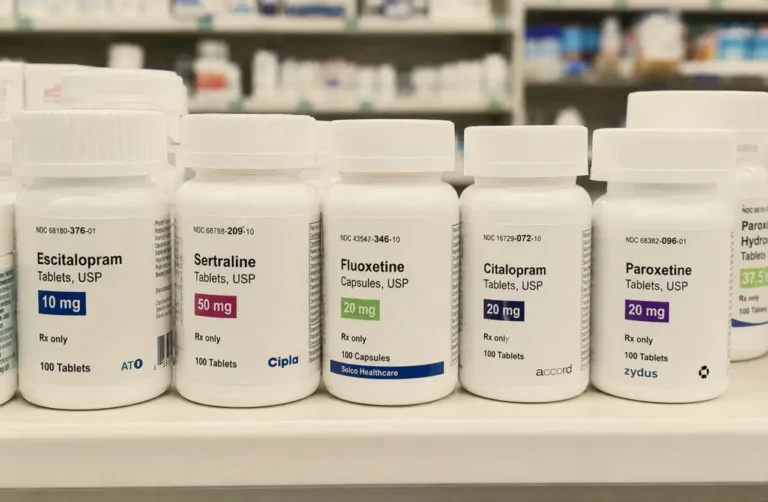
SSRIs (selective serotonin reuptake inhibitors) are antidepressants that slow how quickly the brain reabsorbs serotonin, which leaves more of it active in the brain. The mood-lifting effect they’re prescribed for typically takes up to six weeks to build, a timeline we cover in our guide to starting treatment for depression. The gap between starting a medication and feeling its benefit is exactly why side effects can show up well before any relief does.
One leading explanation for why the early days feel this way is that a rise in serotonin activity may affect the brain’s anxiety-related circuits before it affects the circuits tied to mood.
SSRIs can temporarily increase anxiety in the first week or two on their own, which is why doctors often start at a lower dose when someone already has severe anxiety. Clinicians sometimes call this early reaction “SSRI activation syndrome”, and it has a fairly predictable set of symptoms.
What SSRI activation syndrome feels like
Activation syndrome can show up in the first one to two weeks of antidepressant treatment, or sometimes after a dose increase. It improves significantly as your body adjusts.
- Inner restlessness or a physically wired feeling, what clinicians call “hyperactivity” or “akathisia“
- Trouble sleeping
- Irritability
- Acting more impulsively than usual
- Heightened anxiety or edginess
- Stomach symptoms, including nausea, diarrhea, or loose stools
All of these symptoms are signs that your body is adjusting to the medication, and they typically improve after one to two weeks.
How long do the early side effects usually last?
As a general pattern, most early side effects tend to ease within the first few weeks as your body adjusts, while the medication’s own mood-lifting effect can take up to six weeks to fully build. Two different internal clocks are running at once, which is why early side effects may show up before the benefit does, but many early side effects become easier to manage with time.
When it’s normal, and when to call your doctor right away
Most of what you feel in the first couple of weeks is ordinary adjustment, but there are a few signs that are more serious. Knowing the difference can help you understand what to expect and when to reach out to your clinician.
What’s expected as your body adjusts:
- Mild extra anxiety or restlessness
- A rockier few nights of sleep
- Feeling keyed up
- Headache
- Stomach upset, including nausea, diarrhea, or loose stools
Contact your doctor right away if you notice:
- Any thoughts of suicide or self-harm
- Agitation that feels severe or unbearable
- Symptoms that look like mania, such as euphoria, racing thoughts, or barely needing sleep
- Activation that isn’t improving after several weeks, or feels like it’s getting worse instead of better
Important: Antidepressants can sometimes unmask mania in someone who didn’t know they had bipolar disorder. Sudden manic-looking symptoms need prompt attention rather than a wait-and-see approach.
Antidepressants carry a boxed warning for increased suicidal thinking in young adults under 24, particularly in the early weeks of treatment or after a dose change. If you’re in that age group, or you started or changed a dose in the last few months, it’s worth letting family or a caregiver know the warning signs too, in case you’re not able to call your doctor yourself.
If you are having thoughts of suicide or self-harm, call or text 988 to reach the 988 Suicide and Crisis Lifeline, or chat at chat.988lifeline.org. In an emergency, call 911.
Serotonin syndrome
Serotonin syndrome is a separate, rare reaction, not part of ordinary activation symptoms. It causes a high fever, muscle twitching or stiffness, a racing heart, and confusion, and it needs emergency care the same day, not a routine appointment.
Should you keep taking it, or stop?
Don’t stop or change your dose on your own. Stopping some antidepressants abruptly can cause their own withdrawal-like symptoms. If the early period feels tolerable, staying the course while checking in with your doctor is a normal, common path.
Tell your doctor if symptoms continue to worsen after several weeks, or if side effects are making it hard to function day-to-day. They’ll weigh that against your history and decide what to do next. That might mean adjusting your dose or moving you to a different type of antidepressant.
Frequently asked questions about feeling worse on antidepressants
Can activation syndrome happen with any antidepressant, not just SSRIs?
Yes, though it’s most often described with SSRIs specifically. SNRIs, which also act on serotonin, can cause something similar, and it’s worth mentioning to your doctor regardless of which medication you’re taking.
Is activation syndrome the same as an allergic reaction to the medication?
No. Activation syndrome is a known, expected response tied to how the medication affects serotonin, not an allergic reaction. An allergic reaction usually looks different, such as a rash, swelling, or trouble breathing, and it’s its own separate concern to raise with your doctor right away.
Will activation syndrome happen again if I’ve taken this medication safely before?
It can, especially after a dose increase, though not everyone experiences it a second time. If it happened before and it concerns you now, mention it at your next visit so your doctor can watch for it.
What happens at a QuickMD follow-up visit for medication side effects?
During a follow-up visit, your QuickMD clinician will review your symptoms, discuss any side effects, and assess how you’re responding to treatment. Depending on your needs, they may recommend continuing your current medication, adjusting your dose, or considering a different treatment. Follow-up visits can help you address concerns whether you’ve recently started medication or have been taking it for several months.
Disclaimer
Articles on this website are meant for educational purposes only and are not intended to replace professional medical advice, diagnosis or treatment. Do not delay care because of the content on this site. If you think you are experiencing a medical emergency, please call your doctor immediately or call 911 (if within the United States). This blog and its content are the intellectual property of QuickMD LLC and may not be copied or used without permission.
References
StatPearls Publishing. (n.d.). Selective serotonin reuptake inhibitors. In StatPearls [Internet]. NCBI Bookshelf. https://www.ncbi.nlm.nih.gov/books/NBK554406/
Fischer, A. G., Jocham, G., & Ullsperger, M. (2014). Dual serotonergic signals: A key to understanding paradoxical effects? Trends in Cognitive Sciences. https://pubmed.ncbi.nlm.nih.gov/25532701/
Mayo Clinic. (n.d.). Selective serotonin reuptake inhibitors (SSRIs). https://www.mayoclinic.org/diseases-conditions/depression/in-depth/ssris/art-20044825
MedlinePlus. (n.d.). Sertraline. U.S. National Library of Medicine. https://medlineplus.gov/druginfo/meds/a697048.html
Luft, M. J., Lamy, M., DelBello, M. P., McNamara, R. K., & Strawn, J. R. (2018). Antidepressant-induced activation in children and adolescents. Current Problems in Pediatric and Adolescent Health Care. https://pmc.ncbi.nlm.nih.gov/articles/PMC5828909/
StatPearls Publishing. (n.d.). Serotonin syndrome. In StatPearls [Internet]. NCBI Bookshelf. https://www.ncbi.nlm.nih.gov/books/NBK482377/
988 Suicide and Crisis Lifeline. (n.d.). https://988lifeline.org/
QuickMD has strict referencing policies and relies on reputable sources, including peer-reviewed research, clinical guidelines, medical organizations, and government and public health agencies, among others. Learn more about how we ensure accuracy in our content by reading our editorial guidelines.