What you’ll learn
We’ll cover how long kratom may be detectable in your blood and urine, why that can vary, and what factors may affect how quickly your body processes it. We’ll also explain what to expect if you’re thinking about cutting back or stopping.
How long kratom stays in your system isn’t just about when it leaves your body. How much you use, how often you use it, and how your body processes kratom can all affect the timeline. Knowing what affects that timeline can give you a clearer picture of what to expect and when withdrawal symptoms may begin.
How long will kratom stay in your system?
Kratom doesn’t leave everyone’s body on the same timeline. Based on the estimated half-life of mitragynine, kratom’s main active compound, it may take roughly 1 to 2 weeks for most of it to clear from the body. That estimate is based on how the body processes mitragynine, not on studies showing exactly how long kratom remains detectable on a test.
Detection times can vary depending on how much kratom you use, how often you use it, the type of test, and individual factors that affect how your body processes it.
- A single or occasional dose tends to clear faster, likely within about a week.
- Daily or heavy use pushes the timeline toward the longer end, and some regular users report testing positive well beyond two weeks after stopping.
Kratom’s half-life: why it takes days, not hours, to clear
A “half-life” is the time it takes for half of a substance to clear your blood. Because clearance happens in halves rather than all at once, the tail end tends to linger much longer than people expect.
- In a controlled study, after a single dose, kratom’s main compound took about 43 hours to reach that halfway point. After two weeks of daily use, that number stretched to about 68 hours, simply because more had built up in the body to clear.
- The same study also measured 7-hydroxymitragynine, the compound behind kratom’s stronger, more opioid-like effects, and found it clears much faster: about 5 hours after a single dose, and up to about 25 hours with repeated daily use.
As a general rule, a substance is considered mostly cleared from the body after about 5 half-lives. For kratom, that works out to roughly 9 days after a single dose and up to about 14 days with daily use.
These timelines are estimates, not exact clearance times. How long kratom stays in your body can vary based on your use and how your body processes it.
How long is kratom detectable in urine?
Kratom may be detectable in urine for several days after your last use, and 5 to 14 days is a commonly cited estimate. The exact window can vary depending on how much and how often you use kratom, how your body processes it, and the type of test being used.
Because there isn’t one detection timeline that applies to everyone, it’s better to think of this range as a general estimate rather than an exact cutoff.
Based on the half-life estimates above, kratom may remain detectable on a kratom-specific urine test for roughly 1 to 2 weeks after your last use.
- If you used kratom once or occasionally, you’re more likely to be on the shorter end of that range.
- If you use daily or in high doses, you’re more likely to be on the longer end, or possibly beyond it.
Body chemistry, how concentrated the product was, and how long you’d been using before you stopped can all shift that number in either direction.
This window of detection only matters if the test you’re facing screens for kratom’s compounds in the first place. A standard workplace or court urine panel typically does not test for kratom.
Does a standard drug test actually catch kratom?
No. The federal guidelines that set what a standard workplace drug panel screens for do not list kratom or its compounds anywhere, and the same is true of the common 5-panel and 10-panel tests most employers and courts use.
Detecting kratom requires a specific, separately ordered test for its compounds (mitragynine and 7-hydroxymitragynine), or a broader forensic panel. It isn’t something a routine test happens to catch by accident. See our guide to standard drug test panels for the full panel-by-panel comparison.
Blood, saliva, and hair: what’s known and what isn’t
Blood and saliva testing for kratom is uncommon, and there isn’t a well-established detection window for either type of test.
Hair testing can provide a longer look back at past substance use, often around 90 days with a standard sample length. Kratom can be detected in hair, but kratom-specific hair testing is uncommon.
A handful of confirmed cases have documented kratom compounds in hair. Because detection can vary based on the sample and individual use, the 90-day window is best viewed as a general estimate rather than an exact cutoff for kratom.
What actually changes how long kratom stays in your system
Dose and frequency matter most. A controlled human study found kratom’s half-life nearly doubled after two weeks of daily use compared to a single dose, simply because there was more in the body to clear. Someone who uses kratom several times a day is starting from a very different baseline than someone who has tried it only once.
Liver and kidney function also affect how quickly your body processes and removes kratom’s compounds. Research on kratom’s metabolism shows that the liver and kidneys are the organs that filter and break down kratom’s compounds in your blood. If you have reduced liver or kidney function, you may experience a longer timeline.
Factors like body composition, metabolism, hydration, and urine acidity may also affect how quickly kratom leaves your body. These factors can influence how the body processes and eliminates substances, but their specific effects on kratom can vary. Because of that, no single factor can reliably predict your exact detection timeline.
Does 7-OH clear your system faster than kratom?
7-hydroxymitragynine, the more potent, opioid-like compound sometimes concentrated in kratom extracts and “7-OH” products, has a much shorter half-life than kratom’s main compound, so it likely clears from your blood faster.
Faster doesn’t mean safer.
Concentrated 7-OH products differ from traditional kratom in ways that can increase the risk of dependence, addiction, and overdose.
Can kratom cause a false positive drug test?
Kratom can sometimes cause a false positive for methadone on an initial drug screen. These screening tests look for general chemical patterns rather than identifying an exact substance, and a kratom byproduct may resemble methadone closely enough to trigger a positive result. This interaction has been documented in laboratory testing.
What happens after a positive screening result can vary depending on the testing program. If you believe kratom may have caused a false positive, here are some general steps that may help:
- Ask for a confirmation test before anything else happens. Initial screens are built to flag possible matches, not to be the final answer.
- Tell whoever ordered the test (an employer, a clinic, a probation officer) that you use kratom, so they know to expect and request that confirmation step.
- Keep any documentation of the product you used; some testing programs will ask what you took.
- Talk to your doctor if you’re not sure what to do next. Your doctor can help you understand your results and figure out the next step, especially when the test is tied to something like employment or probation, where the stakes are high.
Common myths about clearing kratom faster
There are a lot of myths about what can affect how quickly kratom leaves your system. Let’s look at some of the most common ones:
- “Water loading” clears kratom faster. Drinking large amounts of water right before a test doesn’t reliably speed up clearance, and drinking an excessive amount in a short window can be dangerous. It can dilute your body’s sodium level enough to cause a medical emergency, with symptoms like confusion, nausea, and seizures.
- Niacin, cranberry juice, vitamin C, and “detox” kits speeding things up. None of them has real evidence behind them for kratom specifically, and some, like high-dose niacin, can cause their own side effects, including flushing, liver strain, and stomach upset.
- “Kratom is natural, so it won’t show up on any test.” It won’t show up on a standard panel, but a test specifically ordered for kratom’s compounds will detect it just like any other tested substance. “Natural” describes where a substance comes from, not whether a lab can find it.
If you’re trying to stop using kratom or 7-OH
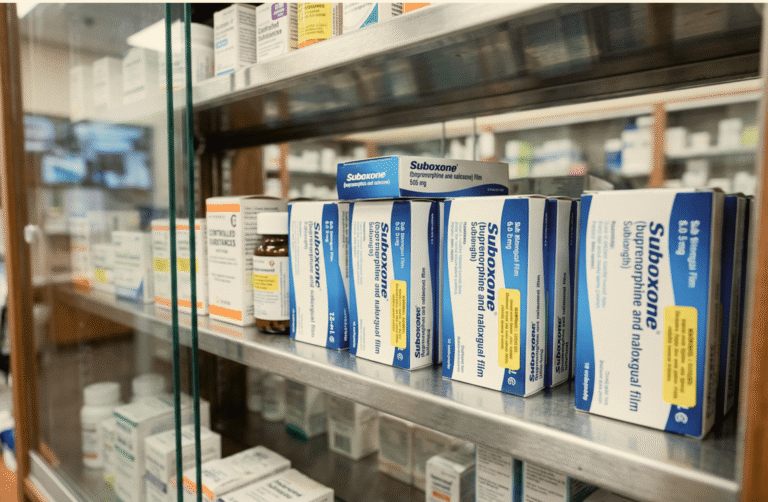
Regular kratom or 7-OH use can lead to physical dependence or addiction. Our doctors understand this type of dependence and can evaluate whether Medication-Assisted Treatment, using buprenorphine-naloxone (Suboxone®), may be appropriate for you.
If you’re thinking about cutting back or stopping, you don’t have to figure it out alone. Our kratom and 7-OH treatment program can help you understand your options so you can take the next step. You can also read more about how Suboxone may be used to treat kratom use disorder.
Frequently asked questions about kratom and drug testing
Can being around someone else’s kratom use cause me to test positive?
No. Kratom isn’t like secondhand smoke that gets into your system through the air. You’d need to take it yourself, not just be near someone using it, for it to show up on a test.
Does it matter if I use kratom powder, capsules, or a concentrated extract?
Yes, potentially. Concentrated extracts and 7-OH products can deliver a much higher dose of active compounds than plain leaf powder or capsules, which may extend the time those compounds remain detectable.
Do at-home kratom test kits work as accurately as a lab test?
Not reliably. At-home kits are designed to provide a quick positive or negative read, but they’re more prone to error than a lab test and can’t report a specific amount or run a confirmation test if the result is unclear.
Does insurance cover a specific kratom detection test, or is it paid out of pocket?
It depends on why the test is being ordered. A workplace or court-ordered kratom-specific test is typically paid for by whoever requested it (an employer, a court, or a testing program), not billed through your personal insurance.
Will a lab report an exact amount of kratom in my system, or just a positive or negative result?
That depends on the type of test. A basic screening test usually reports positive or negative only. A more detailed confirmation test can report an actual measured amount.
If I tell an employer or probation officer I use kratom before a test, does that change anything?
It can, though the outcome depends entirely on that employer’s or program’s own policies. Being upfront at least means they know to expect a kratom-specific result and can route it to the right kind of test, rather than treating an unexpected finding as a surprise.
Disclaimer
Articles on this website are meant for educational purposes only and are not intended to replace professional medical advice, diagnosis or treatment. Do not delay care because of the content on this site. If you think you are experiencing a medical emergency, please call your doctor immediately or call 911 (if within the United States). This blog and its content are the intellectual property of QuickMD LLC and may not be copied or used without permission.
References
Huestis, M. A., Brett, M. A., Bothmer, J., & Atallah, R. (2024). Human mitragynine and 7-hydroxymitragynine pharmacokinetics after single and multiple daily doses of oral encapsulated dried kratom leaf powder. Molecules, 29(5), 984. PMID 38474495
Substance Abuse and Mental Health Services Administration, Center for Substance Abuse Prevention. Mandatory Guidelines for Federal Workplace Drug Testing Programs. Federal Register 90 FR 4662 (Jan. 16, 2025)
Le, D., Goggin, M. M., & Janis, G. C. (2012). Analysis of mitragynine and metabolites in human urine for detecting the use of the psychoactive plant kratom. Journal of Analytical Toxicology, 36(9), 616–625. DOI 10.1093/jat/bks073
Pierre, C., Gineste, C., & Bazydlo, L. (2020). A kratom metabolite causes false positive urine drug screening results for methadone. American Journal of Clinical Pathology, 154(Suppl_1), S19-S20. DOI 10.1093/ajcp/aqaa137.035
Basiliere, S., & Kerrigan, S. (2020). CYP450-mediated metabolism of mitragynine and investigation of metabolites in human urine. Journal of Analytical Toxicology, 44(4), 301-313. DOI 10.1093/jat/bkz108
Rhee, J., et al. (2024). LC-MS-MS method for mitragynine and 7-hydroxymitragynine in hair and its application in authentic hair samples of suspected kratom abusers. Journal of Analytical Toxicology, 48(6), 429-438. DOI 10.1093/jat/bkae041
QuickMD has strict referencing policies and relies on reputable sources, including peer-reviewed research, clinical guidelines, medical organizations, and government and public health agencies, among others. Learn more about how we ensure accuracy in our content by reading our editorial guidelines.